



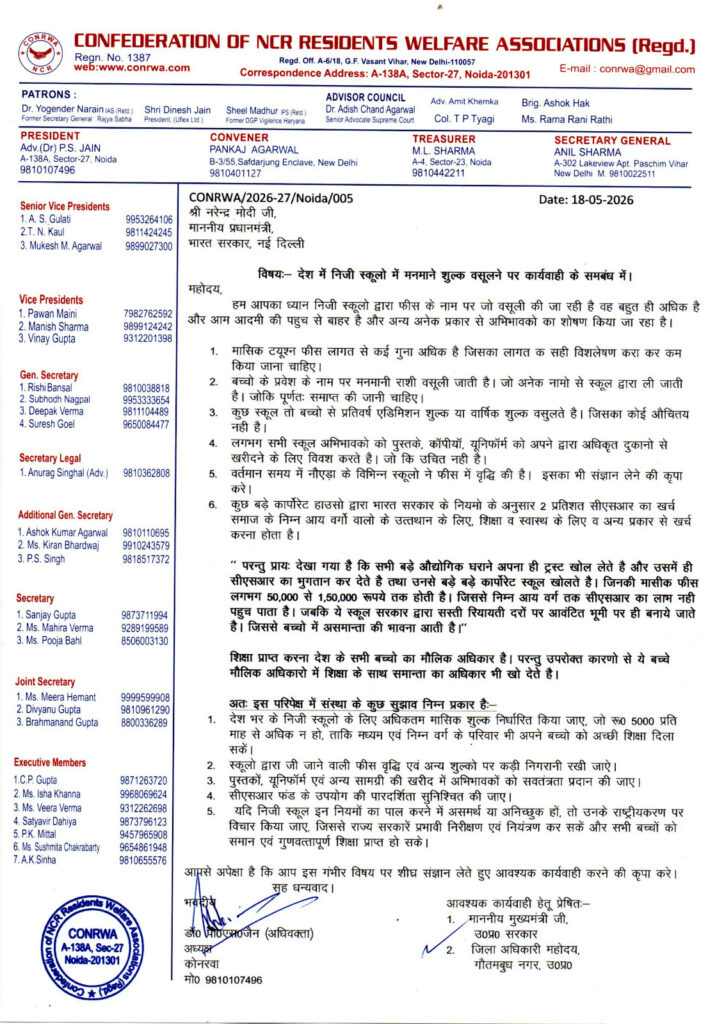
Noida : A growing concern over rising private school fees and alleged exploitation of parents has prompted a formal appeal to Narendra Modi. A memorandum addressed to the Prime Minister has raised serious questions about unchecked fee hikes, annual charges and the functioning of corporate-run schools across the country.
The letter, submitted by advocate Dr. P.S. Jain, President of conrwa, urges the Central Government to intervene and frame strict regulations for private educational institutions. The memorandum highlights that quality education is gradually moving out of reach for middle and lower-income families due to excessive school fees and additional charges imposed by private schools.
Allegations of arbitrary fee collection
According to the memorandum, private schools are allegedly charging tuition fees several times higher than actual operational costs. It states that schools are collecting arbitrary amounts in the name of admission fees, annual charges and re-admission fees without clear justification.
The representation further claims that many schools compel parents to purchase books, notebooks and uniforms only from authorised vendors linked to the institutions, resulting in additional financial burden on families.
The issue of recent fee hikes by several schools in Noida has also been specifically mentioned in the letter, with a demand for immediate government scrutiny.
Questions raised over CSR funding
A major concern highlighted in the memorandum relates to Corporate Social Responsibility (CSR) spending by large industrial houses. The letter alleges that several corporations create their own trusts and use CSR funds to establish expensive corporate schools instead of benefiting economically weaker sections directly.
The memorandum claims that despite receiving land at concessional rates from the government, many such schools charge monthly fees ranging from ₹50,000 to ₹1.5 lakh, making them inaccessible for ordinary families.
It further argues that this creates inequality among children and deprives economically weaker students of their fundamental right to equal educational opportunities.
Key demands made in the memorandum
The organisation has proposed several reforms to regulate private education in India:
- A nationwide cap on private school fees, limiting monthly tuition charges to a maximum of ₹5,000
- Strict monitoring of annual fee hikes and additional charges imposed by schools
- Freedom for parents to purchase books, uniforms and study material from any market vendor
- Greater transparency in the utilisation of CSR funds
- Consideration of the nationalisation of private schools if institutions fail to comply with regulations
Appeal for immediate action
The memorandum states that education is a fundamental right of every child and calls upon the Central Government to take urgent steps to ensure equal and affordable access to quality education.
Copies of the memorandum have also been forwarded to the Chief Minister of Uttar Pradesh and the District Magistrate of Gautam Buddh Nagar for necessary action.
- Unregistered car causes chaos at Amrapali Zodiac, damages vehicles; FIR registered after residents’ protestMore than 100 residents of Amrapali Zodiac society in Noida reached Sector 113 police station after a car without a number plate allegedly entered the premises and damaged several vehicles. NHRF, AOA members and residents jointly sought police action, leading to an FIR being registered late at night.
- Shri Bajrang Ramlila Nyas welcomes Pahal Welfare Foundation officials in Noida
 Shri Bajrang Ramlila Sanchalit Nyas welcomed Pahal Welfare Foundation officials during its Ramleela celebrations in Sector 12, Noida. The event began with the ceremonial lighting of the lamp and highlighted the role of Ramleela in preserving cultural heritage and promoting the ideals of Lord Shri Ram.
 - Seven arrested for kidnapping six-year-old boy in Greater Noida; three injured in police encounter
 Kasna police recover the abducted child and seize illegal firearms, cash allegedly received from child trafficking, a car and a motorcycle. Police say the accused allegedly kidnapped the child and sold him for ₹2 lakh, with another ₹2.5 lakh reportedly pending.
 - Noida police inspect Durga Puja pandal in Sector 137, review security arrangements
 Gautam Buddh Nagar Police inspected a Durga Puja pandal in Sector 137, Noida, under Sector 142 police station limits. DCP Central Noida Dr Praveen Ranjan Singh reviewed security and crowd management arrangements and directed personnel to remain vigilant and ensure devotees’ safety.
 - Noida police inspect Durga Puja pandal, review security and crowd management arrangements
 Gautam Buddh Nagar Police inspected a Durga Puja pandal in Noida’s Sector 20 area to assess security arrangements, crowd management and devotees’ safety. ACP-1 Noida Praveen Kumar Singh directed personnel to remain vigilant and ensure a prompt response to emergencies.
 - Sector 3, Greater Noida West, celebrates Dandiya with devotion at Durga Puja Mahotsav 2026
 Sector 3, Greater Noida West, celebrated Dandiya on October 17 as part of the four-day Pancham Shri Durga Puja Mahotsav 2026. The festival at Park No. 1, B Block, featured cultural programmes, a grand Mata Jagran, Maha Navami bhandara and Vijayadashami celebrations.
 - Lotus Villa: Grand dandiya celebration brought the community together
 Lotus Villa Society in Greater Noida West celebrated a vibrant Dandiya evening on October 16, 2026, with enthusiastic participation from residents, children and women. Organised by the RWA, the event promoted community bonding and cultural traditions. The celebrations continued with a grand Mata Jagran organised by the society’s temple committee on October 17.
 - ‘Need A Flying Tesla’: Bengaluru Traffic Makes 5-Minute Drive Take 2 Hours; Rain Threatens India-West Indies T20I | Bengaluru-news News
 News cities bengaluru-news ‘Need A Flying Tesla’: Bengaluru Traffic Makes 5-Minute Drive Take 2 Hours; Rain Threatens India-West Indies T20I Last Updated:October 17,… Read more: ‘Need A Flying Tesla’: Bengaluru Traffic Makes 5-Minute Drive Take 2 Hours; Rain Threatens India-West Indies T20I | Bengaluru-news News
 - Gr Noida: 38-yr-old man arrested for murdering neighbour
 A 38-year-old man has been arrested for allegedly strangling his neighbour to death in Greater Noida’s Kulesara, police said on Friday. Police identified… Read more: Gr Noida: 38-yr-old man arrested for murdering neighbour
 - DD RWA Federation team attends grand Ramleela celebration in Greater Noida
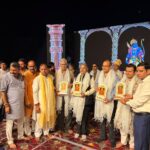 The DD RWA Federation team attended the 17th edition of the Shri Dharmik Ramlila Committee’s annual celebration in Greater Noida on October 16. The event featured an elaborate multi-level stage and honoured federation representatives for their participation in the religious and cultural programme.
 - 5 things you should never leave inside a hot car
 It may seem harmless to leave your phone on the seat, toss a water bottle into the back or keep your handbag in… Read more: 5 things you should never leave inside a hot car
 - The Hidden Consequences of Vaping on Oral Health
 Most people know smoking can damage their teeth and gums, but vaping often gets a free pass. Because it’s marketed as a “safer”… Read more: The Hidden Consequences of Vaping on Oral Health
 - Nine Dry Trees Removed in Sector 51 Drive to Prevent Storm-Related Accidents
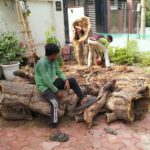 Subtitle: Noida Authority’s horticulture department carried out a special drive on October 10 following concerns over dry branches and trees falling on vehicles… Read more: Nine Dry Trees Removed in Sector 51 Drive to Prevent Storm-Related Accidents
 - DD RWA Federation Team Attends Ramleela Celebrations at Noida Stadium and Sector 12
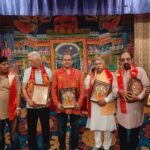 Noida: Members of the DD RWA Federation attended grand Ramleela celebrations organised by Shri Sanatan Dharma Ramleela Samiti (Registered) at Noida Stadium and… Read more: DD RWA Federation Team Attends Ramleela Celebrations at Noida Stadium and Sector 12
 - DD RWA Federation Team Honoured at Ramleela Celebrations in Noida Sectors 46 and 62
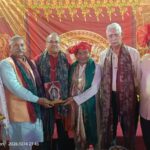 The DD RWA Federation team attended Ramleela celebrations in Noida’s Sectors 46 and 62 on October 14, 2026. Organised by Shri Ram Lakhan Dharmik Leela Committee and Shri Ram Mitra Mandal, the events honoured federation members and celebrated the values of Lord Shri Ram and the preservation of Sanatan culture.
 - Sector 51 :Resident Alleges Groundwater Exploitation and Wastewater Discharge at Under-Construction IKEA MallA Sector 51 resident has alleged that groundwater extracted at the under-construction IKEA mall in Noida is being discharged into stormwater drains. He has urged the Noida Authority to investigate the alleged water wastage and ensure compliance with groundwater conservation and wastewater management norms.
- Centurion Park Tropical Garden: 31-year-old man dies after falling from 21st floor
 A 31-year-old man, Harshit Lavania, died after falling from the 21st floor of Centurion Park Tropical Garden Society in Greater Noida West on Monday evening. Police are examining CCTV footage and questioning people to establish the circumstances leading to the incident.
 - NHAI Introduces Independent Design Checks for Major Bridges and Critical Highway Structures
 NHAI will introduce independent design checks for major bridges, viaducts and critical National Highway structures from December 1, 2026, to improve structural safety, quality and durability across highway projects.
 - Allahabad High Court Stays Supertech Ecovillage-1 AOA Elections Over Voting Percentage Dispute
 Greater Noida West: The Allahabad High Court has stayed the proposed Apartment Owners Association (AOA) elections at Supertech Ecovillage-1 in Greater Noida West… Read more: Allahabad High Court Stays Supertech Ecovillage-1 AOA Elections Over Voting Percentage Dispute
 - Arihant Arden resident alleges cyber identity fraud, Unauthorised orders across multiple platforms
 A Greater Noida West resident alleges that her family has faced unauthorised online orders, suspicious bookings, Amazon Pay deductions and repeated delivery-agent confrontations for over two months. Despite changing her SIM card and handset, she claims the incidents continue and seeks urgent police intervention.
 - Mumbai Airport Terminal 1 Revamp Set For January 2027: Will Your Flight Be Affected? | Mumbai-news News
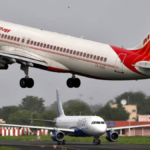 News cities mumbai-news Mumbai Airport Terminal 1 Revamp Set For January 2027: Will Your Flight Be Affected? Last Updated:October 14, 2026, 13:42 IST… Read more: Mumbai Airport Terminal 1 Revamp Set For January 2027: Will Your Flight Be Affected? | Mumbai-news News