


Noida : On World Earth Day, conversations around climate change often stay confined to campaigns and social media posts. But a simple on-ground experiment across Noida and Noida Extension reveals a more immediate and visible truth: urban heat is not just about global warming, it is also about how our cities are being built.
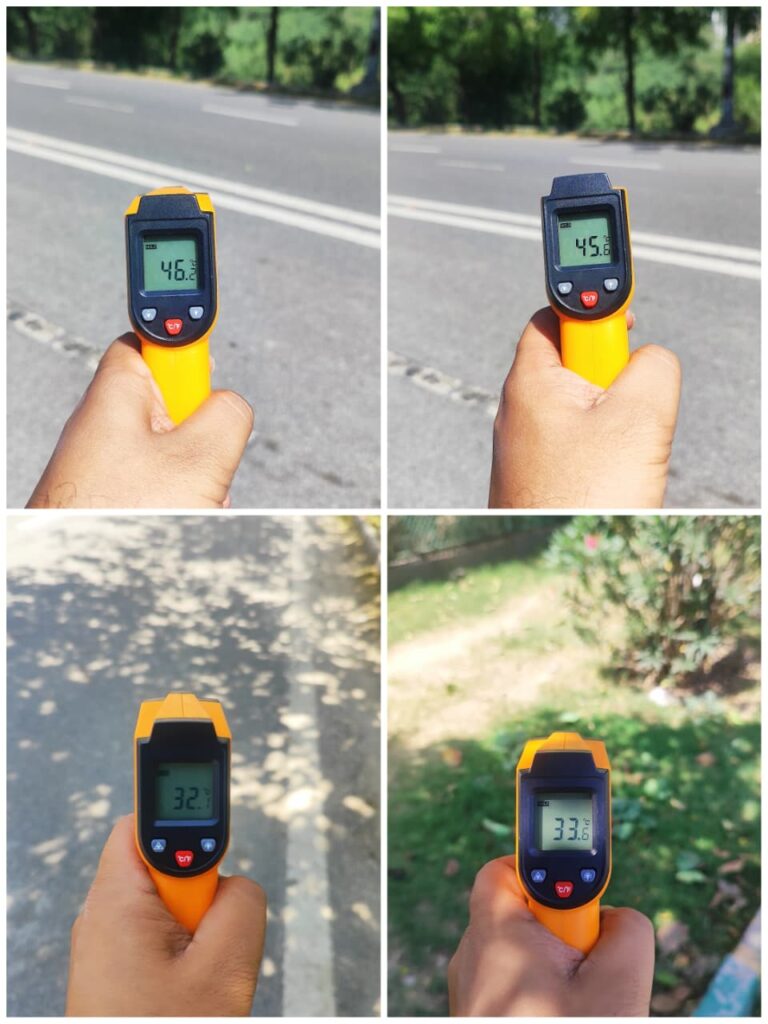
The investigation was conducted by Sector 75 resident Amit Gupta, who carried out temperature readings between 10:30 am and 12:00 noon across multiple locations to understand how different surfaces : asphalt, concrete, grass and tree cover impact heat.
The findings are stark
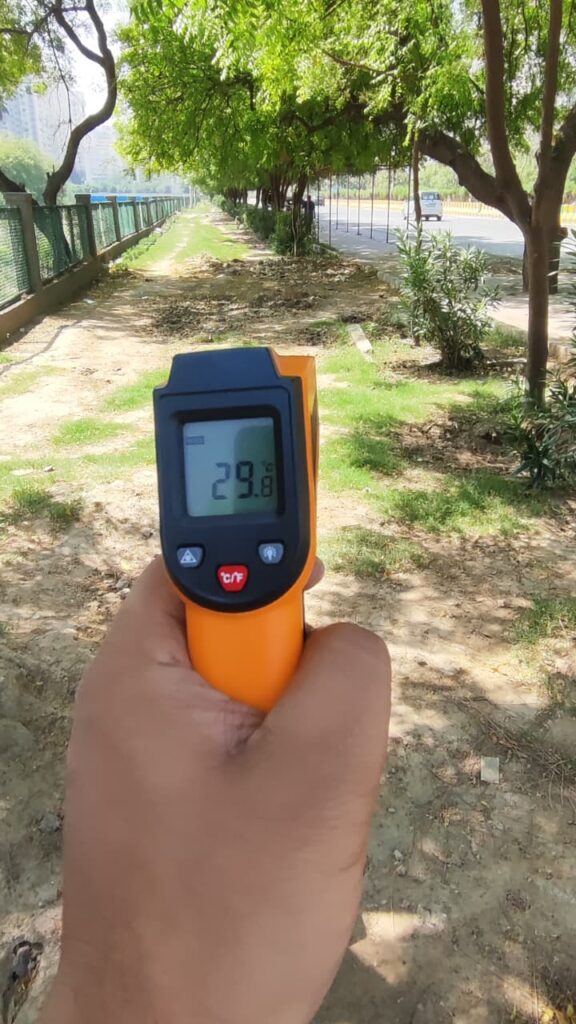
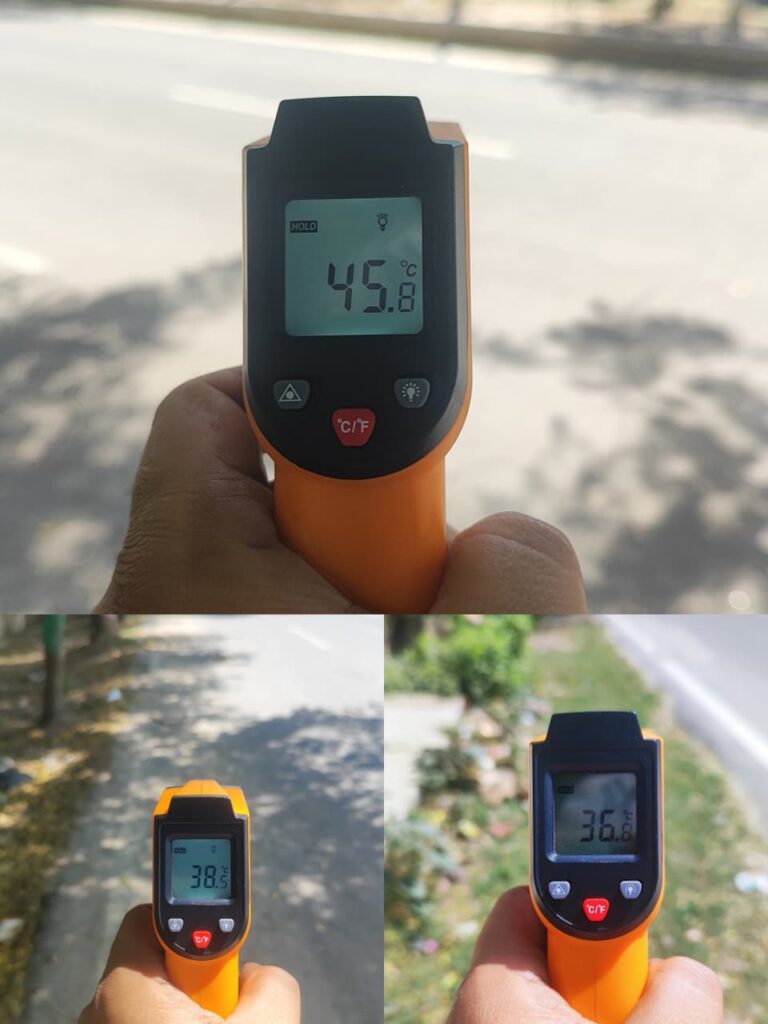
At Sector 77, around 10:30 am, road surface temperatures ranged between 45°C and 46°C. Just a few feet away, under tree cover and over grass, temperatures dropped dramatically to 29°C–33°C. In one stretch with a dense neem belt, the difference touched nearly 17°C.
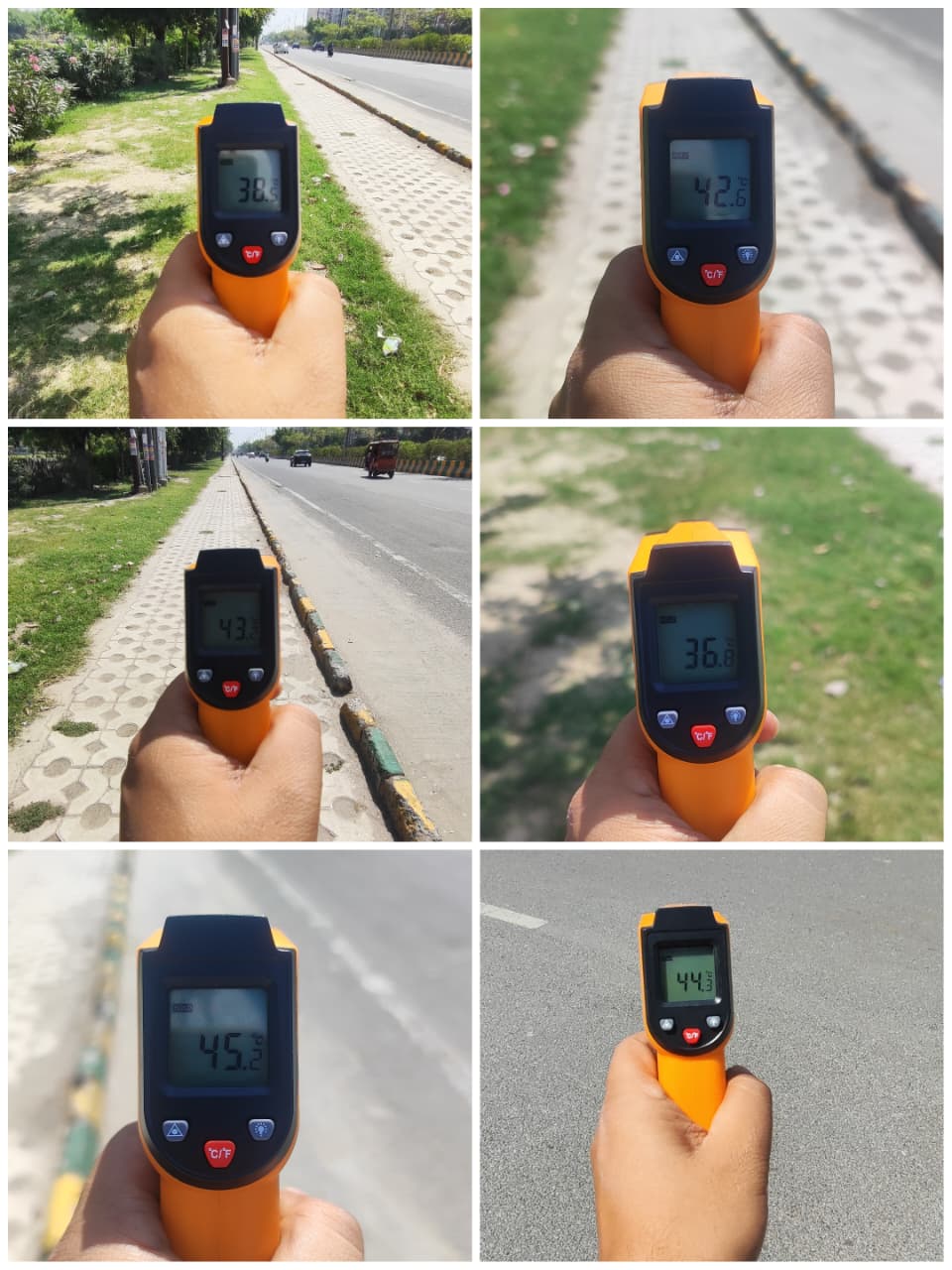
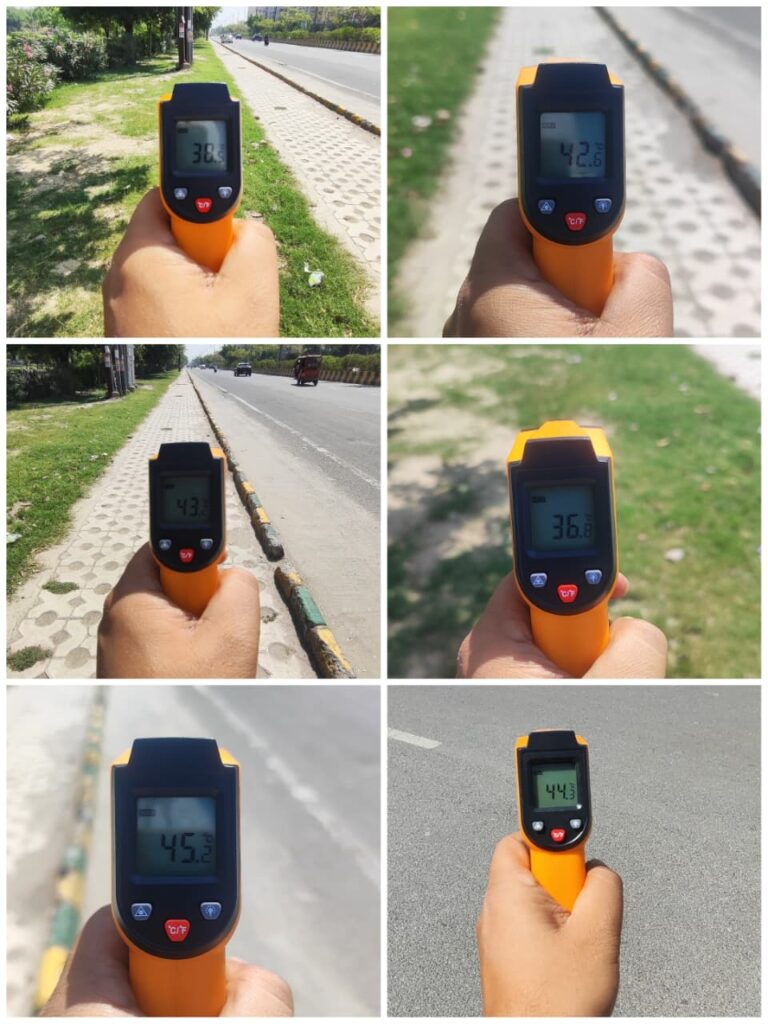
A similar pattern emerged in Sector 116 and Sector 79, where “grass paver” tiles have been installed as part of dust-free zone initiatives. While the road measured around 45°C, the grass paver tiles were at 42°C and nearby grass patches at 38°C. With limited tree cover and direct sunlight, the cooling effect was minimal. The intervention, marketed as green infrastructure, appeared to perform only marginally better than bare concrete.
In Noida Extension near Supertech Eco Village, road temperatures again touched 46°C. Areas with tree cover but no grass recorded around 38°C, while patches with grass but no trees measured about 36°C. Even without trees, grass alone reduced temperatures by nearly 10°C compared to the road surface.
By noon, the situation intensified
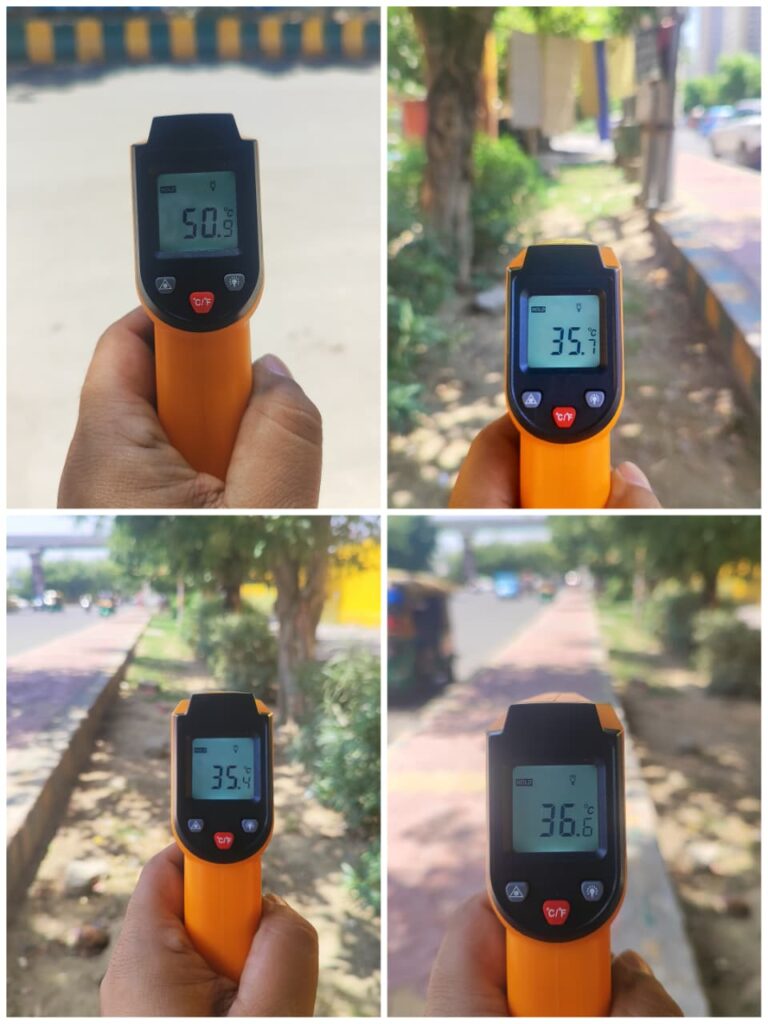
In Sectors 75 and 76, road temperatures peaked at 50°C. In contrast, areas shaded by trees and layered with grass registered between 30°C and 35°C, a difference of up to 20°C.
The pattern is consistent across locations
Where there are trees and natural ground cover, temperatures drop significantly. Where there is concrete, even in the form of “green” tiles, heat persists.
The conclusion is difficult to ignore
Tree-lined roads can bring down surface temperatures by around 10°C. When combined with grass or exposed soil beneath, the reduction can reach 15°C–20°C. However, replacing soil with concrete or tiles under trees limits this benefit, cutting the temperature difference almost in half.
This raises critical questions about current urban planning approaches. In the push to create dust-free and “maintained” spaces, natural cooling systems are being replaced with engineered surfaces that retain heat. Grass pavers, often presented as sustainable alternatives, may not deliver meaningful cooling unless supported by adequate tree cover.
A resident, Sanvarjeet Singh, points to a shrinking green stretch in Sector 79.
There is just one patch of grass lane left now. We managed to save it by planting on both sides, otherwise that too would have disappeared.
Sanvarjeet Singh
His observation reflects a broader trend : incremental loss of green cover in the name of development.
The implications go beyond comfort. Higher surface temperatures contribute to urban heat islands, increase energy demand and directly affect public health. In cities already experiencing extreme summers, the absence of trees and grass can turn roads into heat traps.
The takeaway from this Earth Day is not abstract
Planting trees along roads is not ornamental; it is essential infrastructure. Preserving open soil and grass under them is equally critical. Without these, even well-intentioned urban projects risk worsening the very problem they aim to solve.
As cities expand, the question is no longer whether development should continue, but how. Because at 50°C, the cost of getting it wrong is no longer theoretical; it is already under our feet.
- Shri Bajrang Ramlila Nyas welcomes Pahal Welfare Foundation officials in Noida
 Shri Bajrang Ramlila Sanchalit Nyas welcomed Pahal Welfare Foundation officials during its Ramleela celebrations in Sector 12, Noida. The event began with the ceremonial lighting of the lamp and highlighted the role of Ramleela in preserving cultural heritage and promoting the ideals of Lord Shri Ram.
 - Seven arrested for kidnapping six-year-old boy in Greater Noida; three injured in police encounter
 Kasna police recover the abducted child and seize illegal firearms, cash allegedly received from child trafficking, a car and a motorcycle. Police say the accused allegedly kidnapped the child and sold him for ₹2 lakh, with another ₹2.5 lakh reportedly pending.
 - Noida police inspect Durga Puja pandal in Sector 137, review security arrangements
 Gautam Buddh Nagar Police inspected a Durga Puja pandal in Sector 137, Noida, under Sector 142 police station limits. DCP Central Noida Dr Praveen Ranjan Singh reviewed security and crowd management arrangements and directed personnel to remain vigilant and ensure devotees’ safety.
 - Noida police inspect Durga Puja pandal, review security and crowd management arrangements
 Gautam Buddh Nagar Police inspected a Durga Puja pandal in Noida’s Sector 20 area to assess security arrangements, crowd management and devotees’ safety. ACP-1 Noida Praveen Kumar Singh directed personnel to remain vigilant and ensure a prompt response to emergencies.
 - Sector 3, Greater Noida West, celebrates Dandiya with devotion at Durga Puja Mahotsav 2026
 Sector 3, Greater Noida West, celebrated Dandiya on October 17 as part of the four-day Pancham Shri Durga Puja Mahotsav 2026. The festival at Park No. 1, B Block, featured cultural programmes, a grand Mata Jagran, Maha Navami bhandara and Vijayadashami celebrations.
 - Lotus Villa: Grand dandiya celebration brought the community together
 Lotus Villa Society in Greater Noida West celebrated a vibrant Dandiya evening on October 16, 2026, with enthusiastic participation from residents, children and women. Organised by the RWA, the event promoted community bonding and cultural traditions. The celebrations continued with a grand Mata Jagran organised by the society’s temple committee on October 17.
 - ‘Need A Flying Tesla’: Bengaluru Traffic Makes 5-Minute Drive Take 2 Hours; Rain Threatens India-West Indies T20I | Bengaluru-news News
 News cities bengaluru-news ‘Need A Flying Tesla’: Bengaluru Traffic Makes 5-Minute Drive Take 2… Read more: ‘Need A Flying Tesla’: Bengaluru Traffic Makes 5-Minute Drive Take 2 Hours; Rain Threatens India-West Indies T20I | Bengaluru-news News
 - Gr Noida: 38-yr-old man arrested for murdering neighbour
 A 38-year-old man has been arrested for allegedly strangling his neighbour to death in… Read more: Gr Noida: 38-yr-old man arrested for murdering neighbour
 - DD RWA Federation team attends grand Ramleela celebration in Greater Noida
 The DD RWA Federation team attended the 17th edition of the Shri Dharmik Ramlila Committee’s annual celebration in Greater Noida on October 16. The event featured an elaborate multi-level stage and honoured federation representatives for their participation in the religious and cultural programme.
 - 5 things you should never leave inside a hot car
 It may seem harmless to leave your phone on the seat, toss a water… Read more: 5 things you should never leave inside a hot car
 - The Hidden Consequences of Vaping on Oral Health
 Most people know smoking can damage their teeth and gums, but vaping often gets… Read more: The Hidden Consequences of Vaping on Oral Health
 - Nine Dry Trees Removed in Sector 51 Drive to Prevent Storm-Related Accidents
 Subtitle: Noida Authority’s horticulture department carried out a special drive on October 10 following… Read more: Nine Dry Trees Removed in Sector 51 Drive to Prevent Storm-Related Accidents
 - DD RWA Federation Team Attends Ramleela Celebrations at Noida Stadium and Sector 12
 Noida: Members of the DD RWA Federation attended grand Ramleela celebrations organised by Shri… Read more: DD RWA Federation Team Attends Ramleela Celebrations at Noida Stadium and Sector 12
 - DD RWA Federation Team Honoured at Ramleela Celebrations in Noida Sectors 46 and 62
 The DD RWA Federation team attended Ramleela celebrations in Noida’s Sectors 46 and 62 on October 14, 2026. Organised by Shri Ram Lakhan Dharmik Leela Committee and Shri Ram Mitra Mandal, the events honoured federation members and celebrated the values of Lord Shri Ram and the preservation of Sanatan culture.