




JP Morgan Bond index and bond markets
As India’s government securities (Gsec) begin to be included in this index on June 28, 2024, analysts at HSBC noted in a recent note that three emerging market (EM) nations—Thailand, Poland, and the Czech Republic—are likely to see a reduction in their respective weights in the J.P. Morgan Emerging Market Bond Index (GBI EM index) over the next ten months.
Himanshu Malik, senior global emerging markets rates strategist at HSBC, stated in a recent note that other EM counterparts in the index will experience a fall in their weights to account for India’s 10% weight in the GBI EM index (see chart below).
However, Malik thinks that since India’s participation will be phased in over a ten-month period, the reweighting impact won’t be that big.
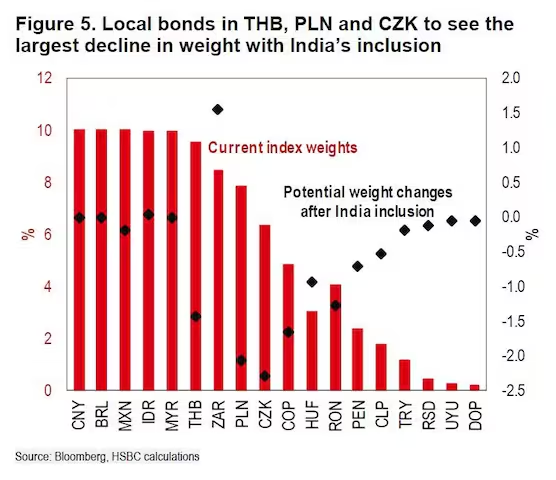
According to his findings, reweighting “is likely to be less meaningful for EM high yielders given their market size, while Thailand, Poland, and Czech are likely to experience the largest reduction in weights at the end of the 10-month period.”
powerful currents
In contrast, following the announcement of inclusion on September 21, 2023, inflows into Indian government bonds have totaled $10.4 billion. In contrast, the first eight months of 2023 saw inflows of just $2.4 billion into Gsec, while the same figures for 2021 and 2022 showed annual outflows of approximately $1 billion each.
Weights by country
When HSBC looked at foreign inflows into Gsec since September 2023, it found that only $8.3 billion had gone into index-eligible bonds, and that 66% of capital had gone into four off-the-run issuance alone.
“Foreign positioning remains lower in the majority of the Gsec that qualify for the index than what their prospective weights in the GBI EM index suggest. According to Mailk, “We believe that a significant portion of the inflows have not yet been realised through the inclusion process, and that these inflows will probably be driven by benchmark issues.”
There are roughly 112 securities in the $1.3 trillion Gsec market. Foreign investment, however, is only allowed in certain liquid benchmark assets, which fall under the Fully Accessible Route (FAR) securities classification. Any new issue with tenors of five, seven, ten, fourteen, or thirty years is categorised under the FAR category by the Reserve Bank of India (RBI).
There are 38 FAR issues at the moment, valued at an impressive $482 billion. The GBI EM index will only include securities that meet certain requirements, such as having a residual term of more than 2.5 years, a minimum outstanding value of $1 billion, and not being green issues. With a weighted average modified duration of 7.06, a weighted average maturity of 12.3 years, and a weighted average coupon of 7% in the index, these 28 securities are now qualified for inclusion in the index, according to HSBC.
Ahead of time, HSBC anticipates that the benchmarks with maturities of 5, 7, 10, and 30 years may be the primary focus of foreign inflows due to their low foreign positioning, auction availability, and relative growth in index weight in comparison to other bonds.