




The largest wine producer in India, Sula Vineyard, is celebrating 25 years of success. Over the next five years, it hopes to boost sales consistently by double digits, helped by growth in the premium and elite categories and the introduction of new ranges.
The vineyards turned their attention to building their own brands and the premium and elite section of the market during COVID-19.
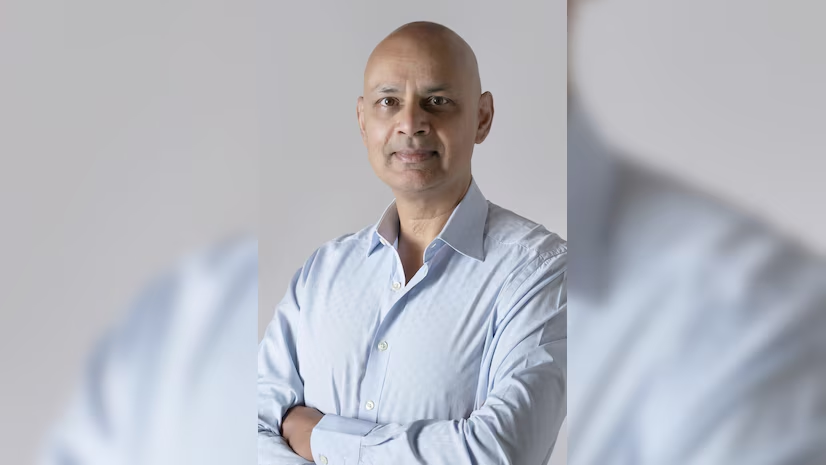
“We switched our attention to dominating the pricing category above Rs. 700 and the elite segment over Rs. 1,000, which competes with international wines, instead of trying to compete in the price-sensitive and discount-driven segment priced between Rs. 250 and Rs. 700. Over the last three years, the voyage has been extraordinarily successful, according to Rajeev Samant, CEO of Sula Vineyards.
Over the past three years, the winery’s premium and elite segment has expanded at a compound annual growth rate of 15-20%.
The segment’s share of our revenues has increased to nearly 80% from 55% four years ago. It’s a significant change. We anticipate strong double-digit growth in these two areas going forward,” he continues.
Premiumization is still a major growth driver for the winery, but expansion and innovations are also planned to help it continue to grow by double digits.
In the upcoming two years, the winery plans to expand its source range beyond its native Maharashtra and Karnataka. The source pinot noir was recently added to the lineup.
Demand growth in non-traditional areas is currently outpacing that of Maharashtra and Karnataka, our core markets. We are witnessing robust growth of fifty percent in Delhi, over forty percent in Rajasthan, and around thirty-five percent in Uttar Pradesh,” notes Samant.
“We anticipate that non-traditional markets will continue to develop at a quicker rate, which will have an effect on our profitability. But for the next ten years, that’s how we make sure we can grow the wine category in India more quickly than beer and cigarettes,” he continues.
With 35 new keys added in the previous ten months and more planned, wine tourism is another area of growth Samant is concentrating on.
For us, FY24 concluded with nearly 90% occupancy rates, which was a really positive sign. We will see occupancy cross 90% in the third and fourth quarters of the year, he says. Wine tourism is still seasonal. Currently, the goal is to install 30 more keys in Nashik during the second half of the current fiscal year.
Along with the recently purchased ND wines, the winery is investing little less than Rs 100 million on the development of tourism at the two adjacent Bengaluru vineyards.
He continues, “We also have plans to create rooms at the Bengaluru vineyard, which we hope to finish in 18 months.
In addition to two dining spaces, a terrace tasting room, a tasting cellar, a gift store, and an extension of the bottle shop from its existing 100 square feet to 800-1,000 square feet, ND Wines will offer these features.