


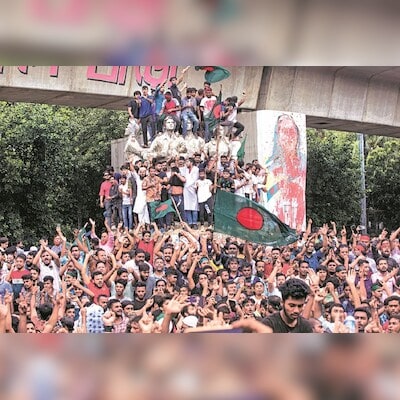

Sheikh Hasina, the 76-year-old prime minister of Bangladesh, was forced to step down and leave Dhaka on Monday due to weeks of intense anti-government rallies that left hundreds dead. Hasina arrived at Hindon Airport, an Indian Air Force facility close to Delhi, on Monday afternoon while travelling to London aboard a military transport aircraft (C 130J). Her sister was also travelling with her.
Hasina’s resignation was announced earlier in the day by Bangladesh Army Chief Waker-uz-Zaman, who also promised to work towards forming an interim government. President Mohammed Shahabuddin of Bangladesh issued an order late in the evening releasing Khaleda Zia, a prominent opposition figure and imprisoned former prime minister.
During Hasina’s 15 years in office—she was elected to a fourth term earlier this year—bilateral ties between Bangladesh and India have never been stronger on the strategic and economic fronts.
The Cabinet Committee on Security (CCS) discussed the most recent events in Bangladesh during a meeting on Monday night at the prime minister’s official residence, according to sources. Other members of the CCS who attended the meeting with Prime Minister Narendra Modi included Finance Minister Nirmala Sitharaman, Home Minister Amit Shah, Defence Minister Rajnath Singh, and Minister of External Affairs S Jaishankar.
On Tuesday, a statement from the Parliament regarding the circumstances in India’s neighbour is probably in order.
Ajit Doval, the national security adviser, met Hasina at the airbase close to Delhi with senior officials in tow. According to sources, Doval discussed India’s stance on the events in Bangladesh. It is understood that Hasina has been relocated to a secure area because it is improbable that she will depart India on Monday evening.
The Border Security Force (BSF) along the 4,096-kilometer India-Bangladesh border declared a “high alert” across all of its formations in response to the events in Dhaka. Due to airport closures in the Bangladeshi capital, Air India cancelled its flights to Dhaka and an IndiGo flight from Chennai headed for Dhaka was rerouted to Kolkata.
Since the protests began last month on July 19, trains between India and Bangladesh have been banned and will stay that way indefinitely. While they anticipated that things would soon return to normal, Indian exporters stated that the current events will negatively impact bilateral trade.
Hundreds of people burst into Hasina’s home as word of her departure from Dhaka spread, plundering and vandalising the interiors, giving dramatic expression to the anti-government rallies that have claimed over 100 lives in the past two days. The contentious quota system implemented by the Hasina government, which reserves 30% of jobs for the families of veterans of the 1971 liberation war, is the main source of resentment among the general public.
The Army chief declared that the prime minister had resigned as unruly crowds took to the streets, with some clambering on Hasina’s father and Bangladesh founder Sheikh Mujibur Rahman’s statue and shattering it with hammers in a memorable scene highlighting the fickleness of history.
In a broadcast speech, he announced the formation of an interim administration. “I am assuming full responsibility for the nation.” Zaman, who was named the Army Chief in June for a three-year tenure, stated, “Please cooperate.” The head of the Army claimed to have spoken with political figures and informed them that the Army would assume command of law and order. But Hasina’s Awami League party leaders were not present during the meeting.
The army leader claimed he had ordered the Army and police to refrain from using force as protests spread around the nation.
Zaman also encouraged demonstrators to put an end to the violence and exercise restraint. He vowed “justice” for all. Following the August 1975 coup that killed Hasina’s father, Rahman, the Army maintained direct or indirect political authority over Bangladesh for fifteen years, until her victory in 2008.
Diplomatic sources in New Delhi confirmed Monday afternoon that Hasina had landed at the Hindon airbase in Ghaziabad on her way to London. She is likely to meet her daughter Saima Wazed, who is based in Delhi and working as the WHO’s regional director for South-East Asia, a PTI report said.
In Dhaka, the Bangabandhu memorial museum – dedicated to Mujibur Rahman who was assassinated along with his wife and their three sons while serving as president in 1975 – was also vandalised. Because they were overseas, Hasina and her sister Sheikh Rehana had escaped the purge. Hasina then spent six years in exile in India. The home of Dr Wajed Miah, Hasina’s husband, was not spared either in the vortex of violence on Monday, local reports said. Four Hindu temples suffered “minor” damages across the country, eyewitnesses and a community leader said. An India-Bangladesh cultural centre, set up in 2010, suffered damage.
The violence was not restricted to Dhaka. In the eastern city of Sylhet, offices of the deputy commissioner and superintendent of police were reportedly set on fire, while the homes of several councillors were attacked, BBC reported.
The clashes between protesters demanding Hasina’s resignation and the ruling Awami League supporters in different parts of Bangladesh on Sunday erupted days after more than 200 people were killed in violent clashes between police and mostly student protesters. At least 300 people have been killed within a fortnight.
The government in the morning ordered a complete internet shutdown as protestors asked the general public to join a “Long March to Dhaka”. However, a government agency later gave a verbal order to start broadband internet around 1:15 on Monday. The day began with an eerie calm, but it turned violent after supporters of the ruling Awami League descended on the streets to subdue anti-government protests who defied curfew to gather for the “Long March to Dhaka”.
The protests could have a fallout on Bangladesh’s thriving textile exports. A spokesperson for Hennes & Mauritz (H&M), the world’s second-biggest fashion retailer, which has many suppliers in Bangladesh, told Reuters that it is concerned about the developments and the violence. Clothing manufacturer Hula Global, which serves major US store chains, said it had re-directed its apparel orders from Bangladesh to India for the rest of the year because of the unrest. “We do not want to risk our existing order book because of the political turmoil,” it said.
The situation in Bangladesh also poses challenges for India’s substantial public and private sector investments in the energy and infrastructure sector of Bangladesh. An investment that made headlines was Adani group’s 800 MW Godda power project in Jharkhand, which is sourcing coal from the group company’s coal mine in Australia to supply power to Bangladesh. In line with a long list of rail connectivity projects, both sides have also signed an MOU extending transit facilities for movement of Bangladeshi goods to Nepal and Bhutan through the Indian railway network. As of now, five links connecting India with Bangladesh have been made operational. Indo-Bangladesh trade ‘halted’ with the Bangladesh government on Sunday announcing a three-day trade holiday, excluding essential services, through a notification. Till July 22, about 2,894 Indian students studying in Bangladesh had crossed over to India, while another about 3,000 students are expected to come now, official sources said.
The first half of 2024 witnessed frenetic India-Bangladesh bilateral interactions. Hasina assumed office in January 2024 after her historic consecutive 4th term victory. She attended the swearing-in ceremony of Prime Minister Modi and the Council of Ministers in Rashtrapati Bhavan on June 9 along with other Indian Ocean Region leaders.
In an interview to BBC, Hasina’s son and former official adviser Sajeeb Wazed Joy said there would be no political comeback for his mother and that she left the country for her own safety on her family’s insistence. He said that Hasina had been considering resigning since Sunday and had left the country for her own safety after her family insisted. “She has turned Bangladesh around. When she took over power, it was considered a failing state. It was a poor country. Until today it was considered one of the rising tigers of Asia. She’s very disappointed,” he said.