


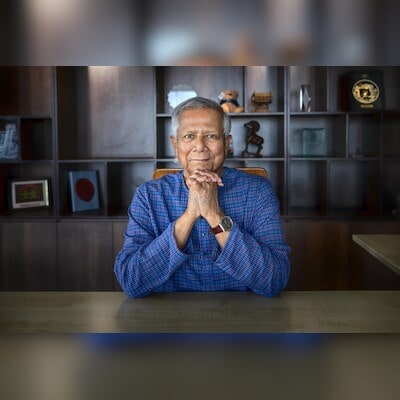

Bangladesh is depending on one of the most well-known academics in the country to restore stability to a nation plagued by political unrest and coups.
A new temporary government led by Muhammad Yunus, who received a Nobel Peace Prize for his efforts to reduce poverty, was announced on Tuesday in the wake of Sheikh Hasina’s abrupt resignation as prime minister earlier this week. Despite his general avoidance of politics, Yunus is one of Bangladesh’s most recognisable figures and has significant influence with Western elites.
For Yunus, returning Bangladesh to normalcy won’t be an easy task. More than 300 people have died in protests and skirmishes with security forces over the last two weeks, making this one of the worst violent episodes in the history of the South Asian country. Even though Hasina was able to bring millions out of poverty through the export of garments, Bangladesh’s economy has recently slowed, necessitating the intervention of the International Monetary Fund with bailout monies.
For the economist, Yunus’s appointment as Bangladesh’s temporary leader, supported by the military, is a significant development. Yunus has devoted much of the last few years to defending himself and his friends against over 200 charges, which include graft and money laundering claims. He and his allies claim that Hasina’s government was responsible for the legal pressure, possibly considering him a danger to her authority. She refuted those claims.
The 84-year-old Yunus is most recognised for starting Grameen Bank and developing microcredit, which offers small business loans to the world’s poorest individuals, the majority of whom are women. Despite having lived much of his life in the spotlight, politics is still a somewhat uncharted territory for him. The military took over the government of Bangladesh in 2007 after it broke apart. Having never ran for office, Yunus thought about creating a new party to fill the void, but he eventually gave up on the idea after only a few weeks.
In an interview conducted earlier this year, he stated, “I feel very uncomfortable with politics.”
Yunus is a popular option among many Western nations and lends celebrity power to the post. His fans come from all walks of life and all sectors. He has developed relationships with European royalty, corporate moguls such as Richard Branson, and the Clinton family over the years, all of whom have assisted Yunus in bringing his microcredit programs to the US. According to his acquaintances, he is a unique visionary who genuinely cares about Bangladesh and helping the underprivileged.
Paul Polman, a personal friend and former chief executive of Unilever Plc, described him as “the voice of the people left behind.” “He is an upright leader. He’s not the type to brag about himself easily. He enjoys chatting about the clients he works with.
Many in Bangladesh, especially the military, which had previously backed his initial attempt at politics, now hold a favourable opinion of him due to this reputation. Seeking his words, hundreds of Bangladeshis packed venues following his 2006 Nobel Peace Prize victory. When they see him, many still bow and touch their hearts. Yunus has spent the last ten years concentrating on growing dozens of social enterprises, such as those that provide free phone services, vocational training, and health care to Bangladeshis in lower socioeconomic situations.
It is uncertain if Yunus enters politics more consciously or if he just steps in to cover a void before elections are scheduled. Yunus publicly denounced the violence and called Hasina’s response a threat to democracy as demonstrators flocked Dhaka’s streets in recent weeks, but he said nothing about his desire to play a more official role in forming a new administration.
He declared in the interview from earlier this year, “I’m not a politician.” “I will never do this again. It is my last act.”