


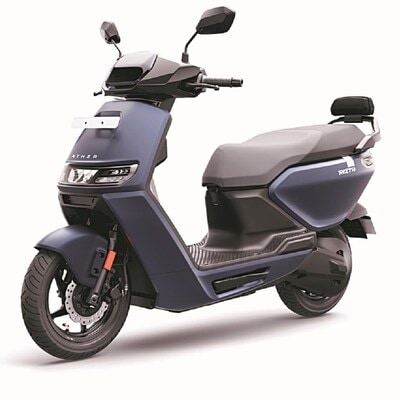

Despite a decrease in subsidies, Ather’s co-founder underlined the government’s supporting role.
According to Swapnil Jain, co-founder of Ather Energy, India can surpass its worldwide competitors in terms of design and technology, and its electric two-wheelers are superior to all others in the world.
Speaking at the ‘Meet Rizta’ event in Nagpur, where Union Minister of Road Transport & Highways Nitin Gadkari was present, Jain emphasised the progress made by Indian manufacturers and the nation’s exceptional potential to become a technology exporter for the world.
Ather presented the cutting-edge Halo helmet and its newest family scooter, Rizta, to an audience of locals and lovers of electric vehicles during the event.
Speaking to reporters, Jain highlighted that even with fewer subsidies, the government still plays a supportive role.
“Even with decreased subsidies, we are thriving thanks to the ‘Made in India’ initiative,” he said.
He claimed that Indian electric two-wheelers are the best in the world and that the nation has a special chance to advance in design and technology relative to other nations.
Jain went into detail on how India can become the first country to outpace other nations in EV design and technology.
We have a special chance to move from being manufacturers to exporters of technology. The semiconductor, software, cell manufacturing, and energy businesses will all benefit from the expansion of the electric two-wheeler market, he predicted.
Jain went on to say that all new innovations in the nation may be pulled by the electric two-wheeler industry.
“EV industry should not be seen just as an automobile industry but as the industry that can pull all the new technology in India, which will flourish various other industries,” he stated.
Ather has seen tremendous expansion, selling almost 1,15,000 EVs last year, up 30% from the previous year.
With the favourable reception of the Ather Rizta, Jain expressed hope about future sales and mentioned the company’s 4,00,000 unit production capacity.
In terms of growth, Jain disclosed intentions to enter the South Asian market, with sales having already started in Nepal.