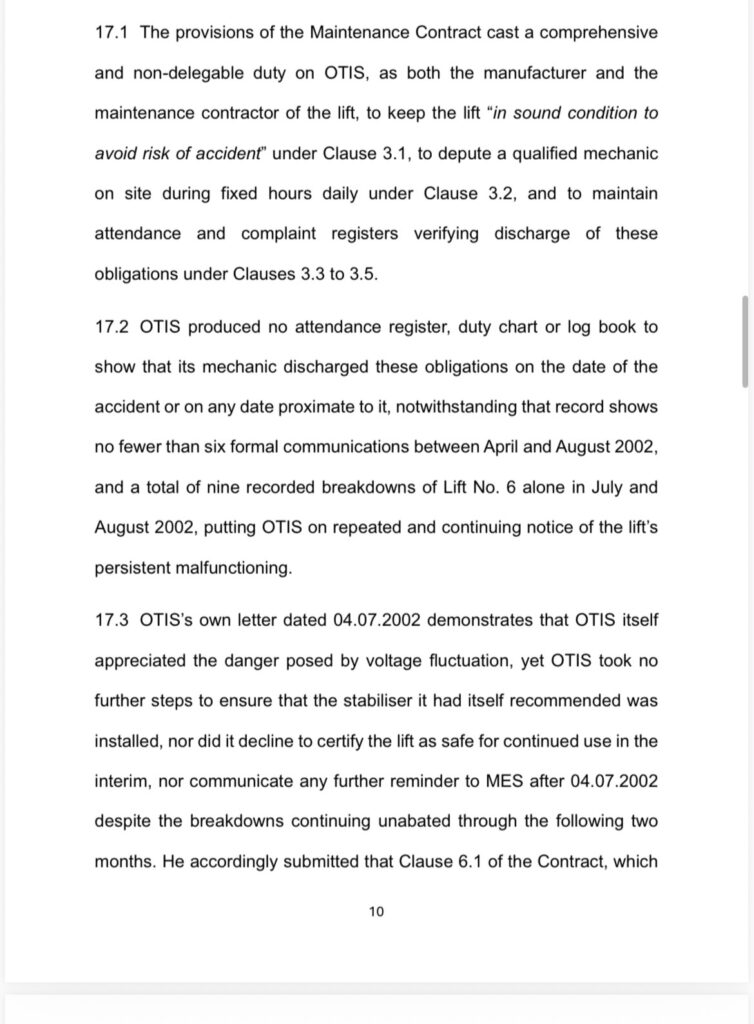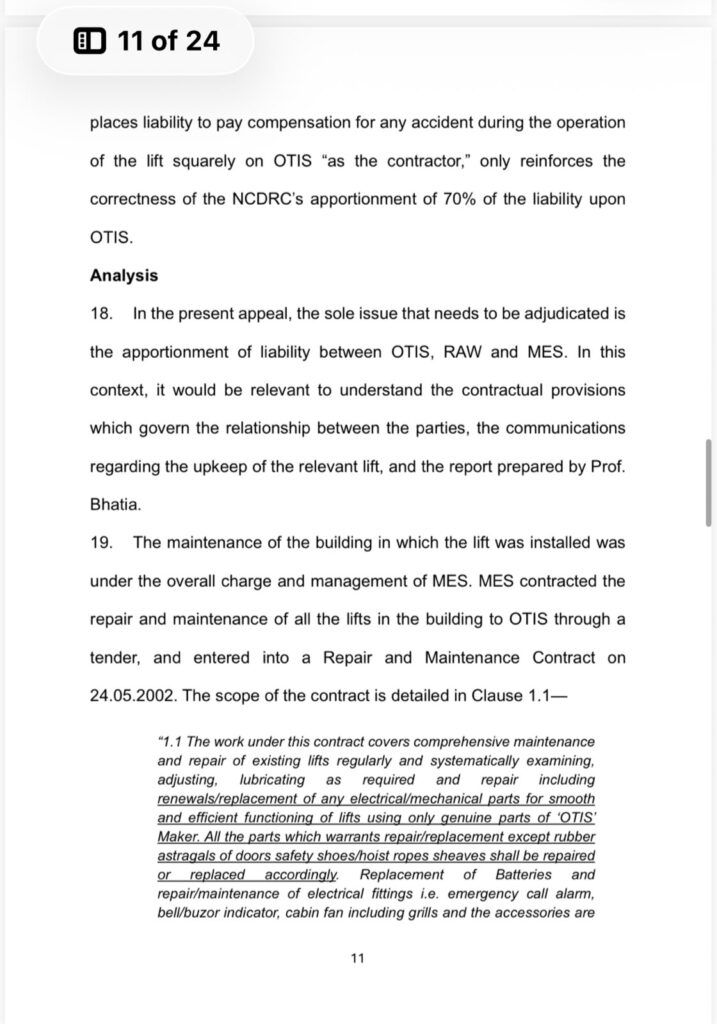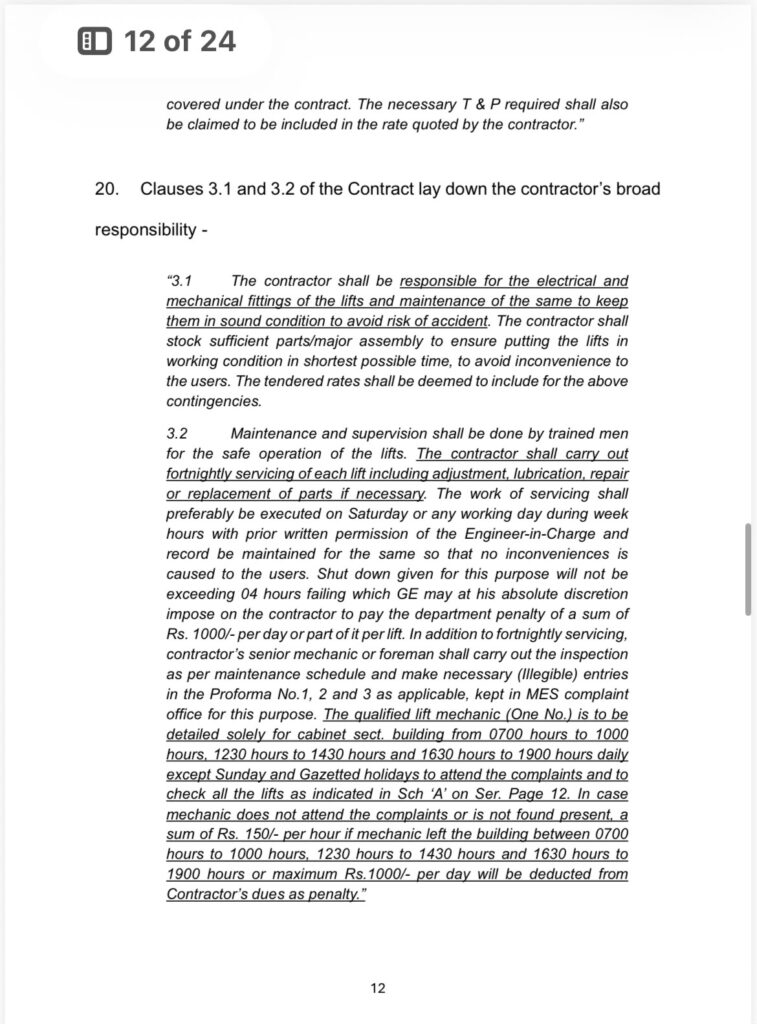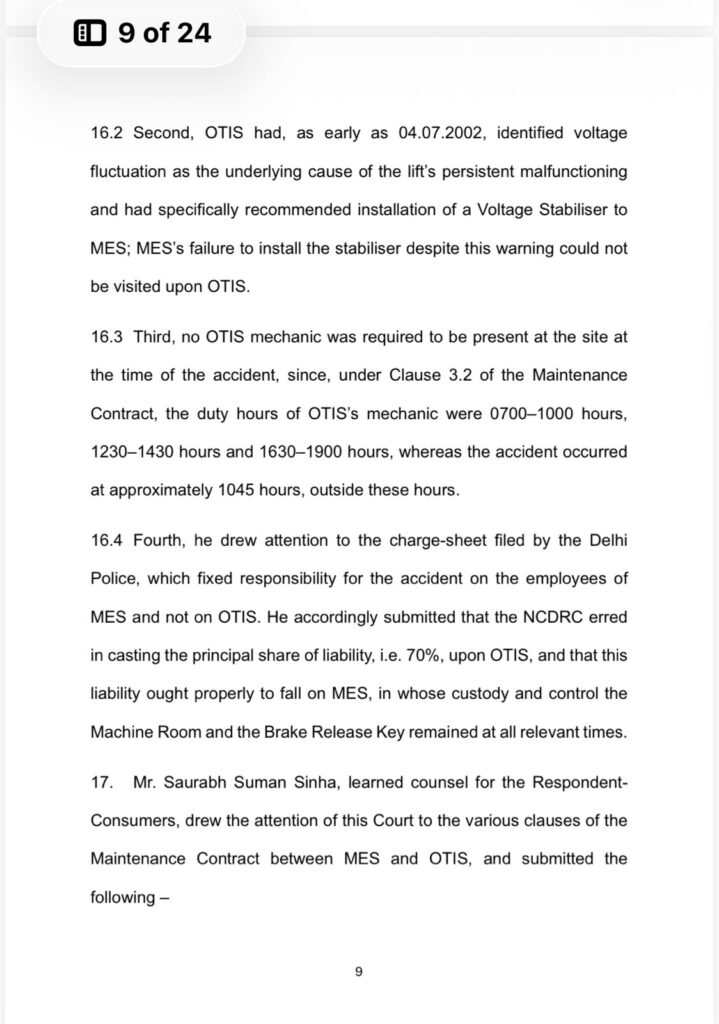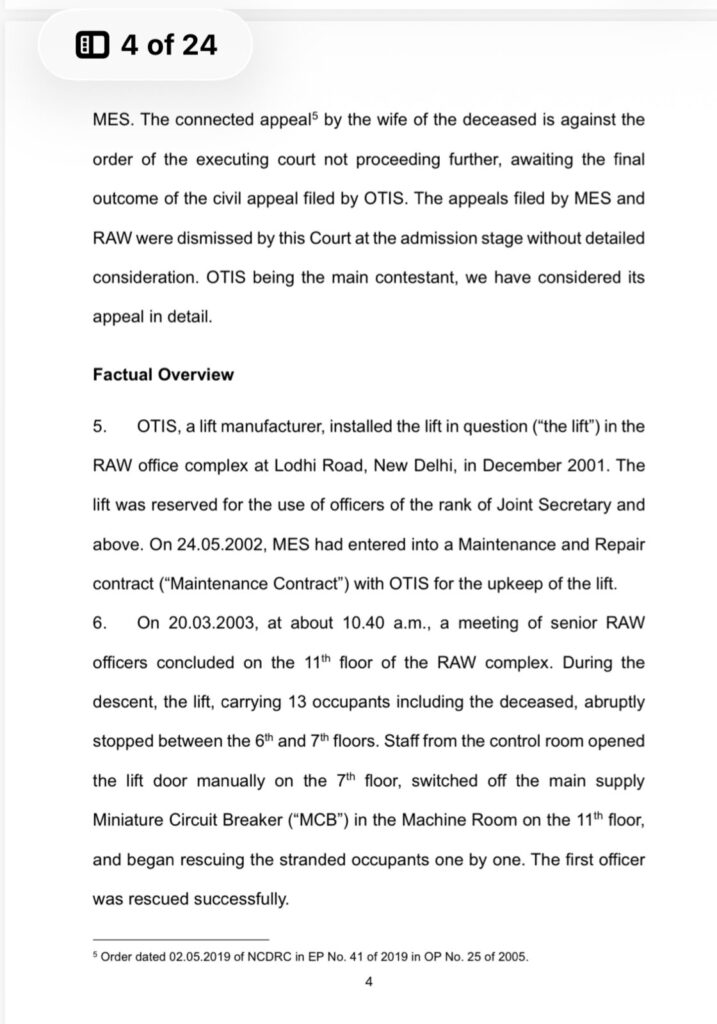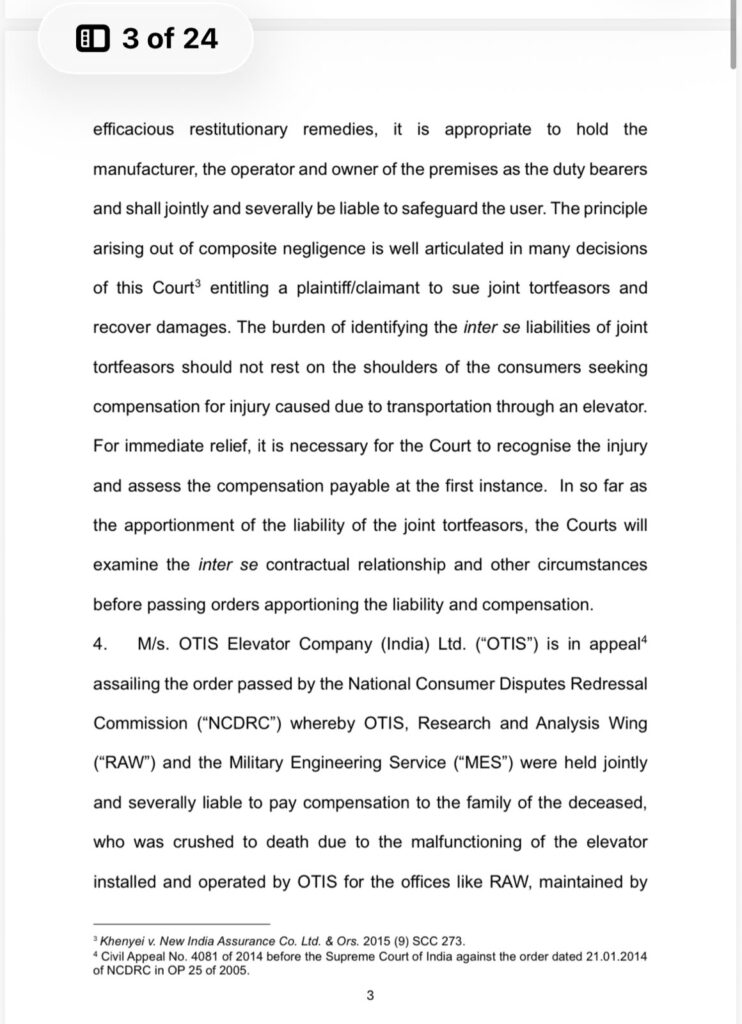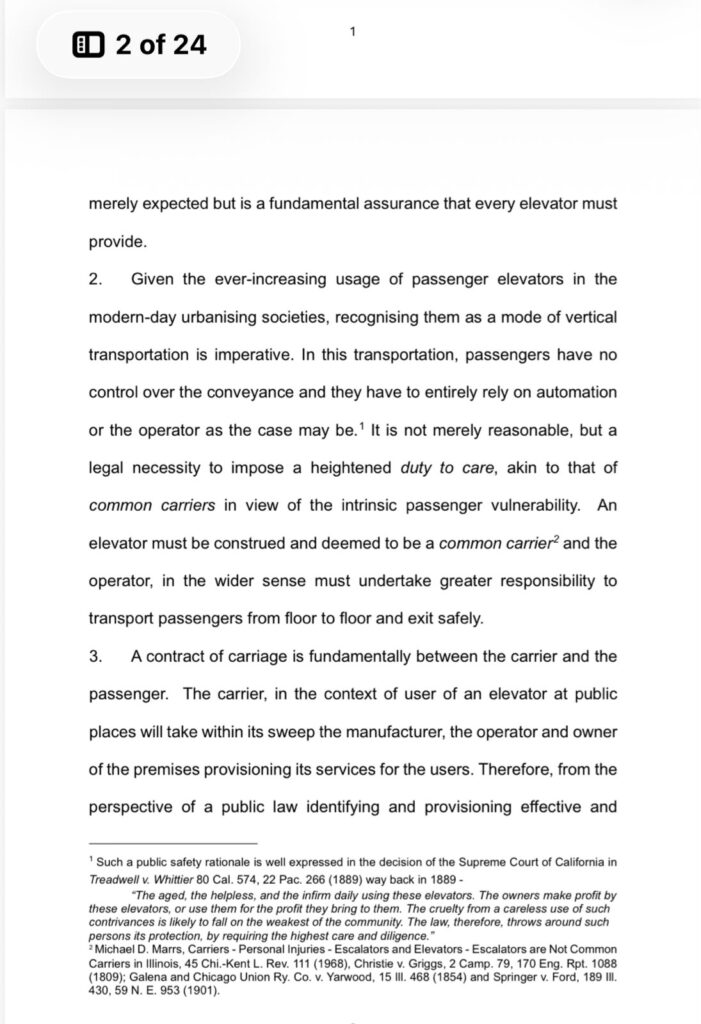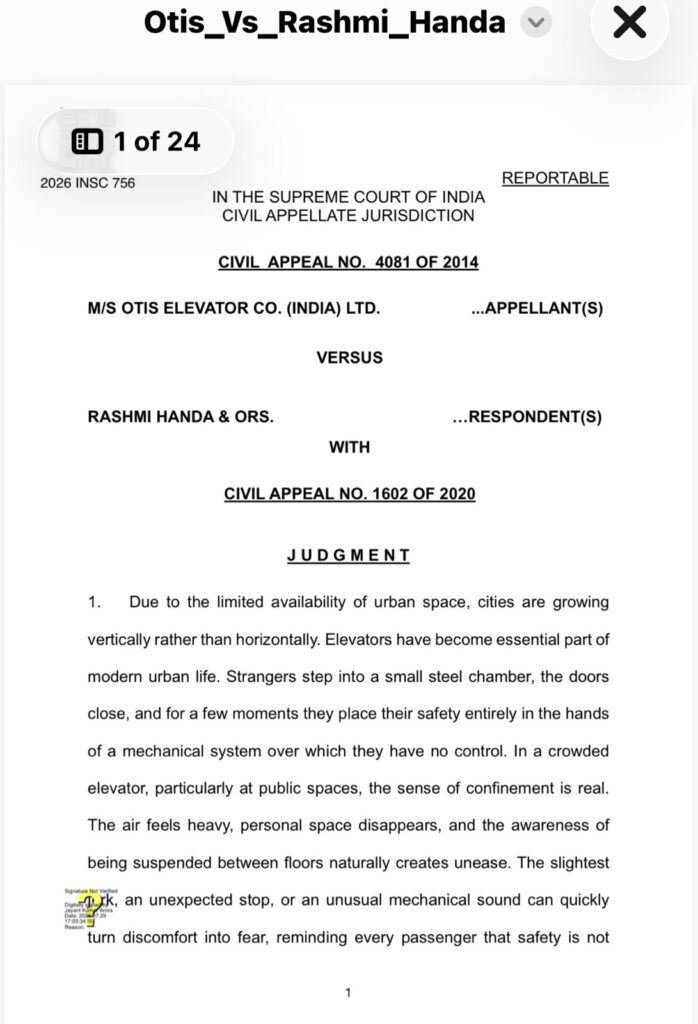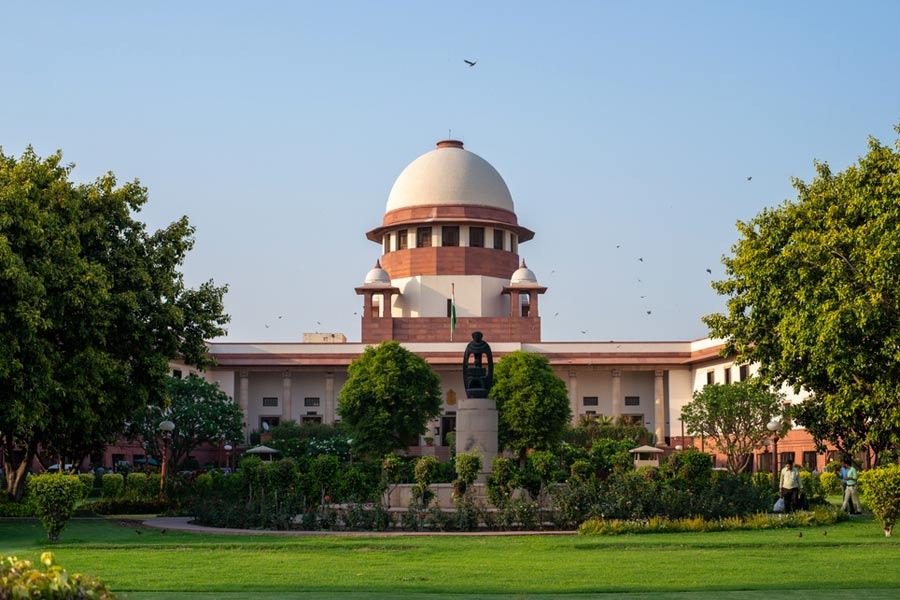
New Delhi: Millions of people use lifts every day in residential societies, offices, hospitals, hotels and commercial buildings. In a significant ruling concerning elevator safety, the Supreme Court has held that manufacturers, maintenance operators and owners of premises housing lifts have a joint responsibility to ensure passenger safety.
The judgment came in a case arising from the death of former diplomat and R&AW officer Vipin Handa in a lift accident in New Delhi in 2003. A bench of Justices P.S. Narasimha and Alok Aradhe upheld the compensation awarded to Handa’s family and dismissed the appeal filed by Otis Elevator Company (India) Ltd.
Supreme Court Treats Lift As A ‘Common Carrier’
The Supreme Court observed that passengers place their safety in an automated system over which they have little or no control once they enter a lift.
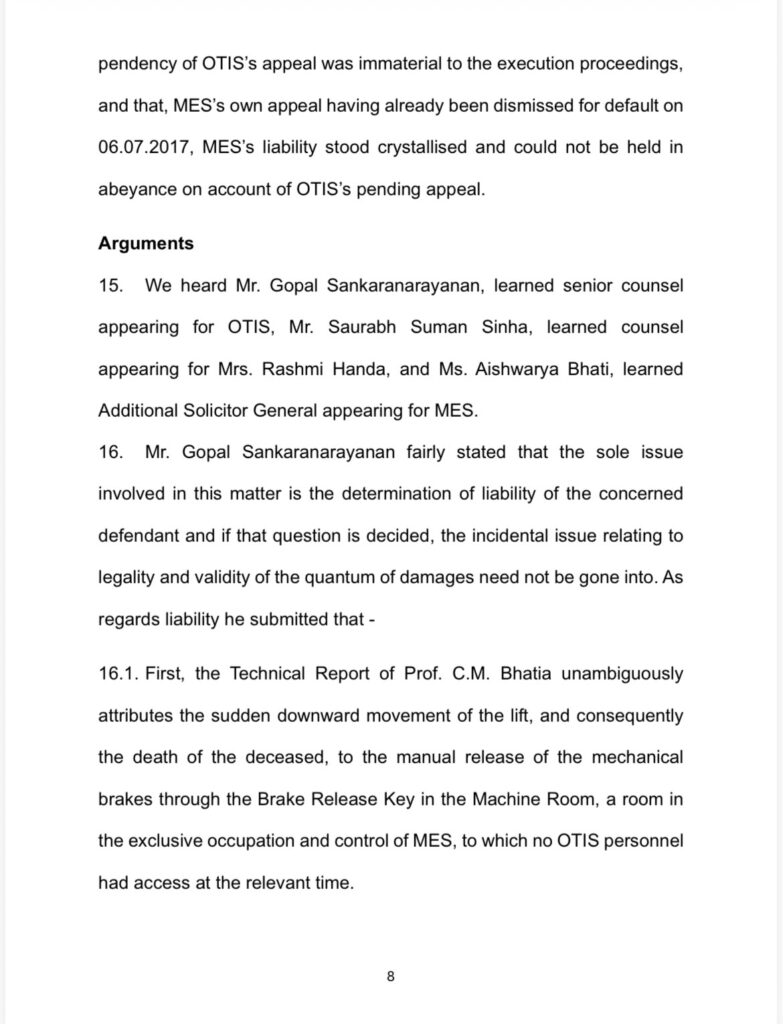
The Court held that an elevator should be treated as a “common carrier” and that the manufacturer, maintenance operator and owner of the premises collectively have a heightened duty of care towards passengers.
This means responsibility for passenger safety cannot simply be shifted from one party to another when an accident occurs.
Victims Do Not Have To Establish Each Party’s Exact Share First
One of the important aspects of the ruling is that a victim or the victim’s family does not have to first determine the precise share of negligence attributable to every party involved before seeking compensation.
The Court held that the parties can be jointly and severally liable, allowing the victim to recover the compensation from any of the liable parties. The parties can subsequently determine how the liability should be divided among themselves.
This approach can prevent victims from being caught between manufacturers, maintenance contractors and building management, each of whom may otherwise attempt to shift responsibility to another party.
Case Dates Back To 2003
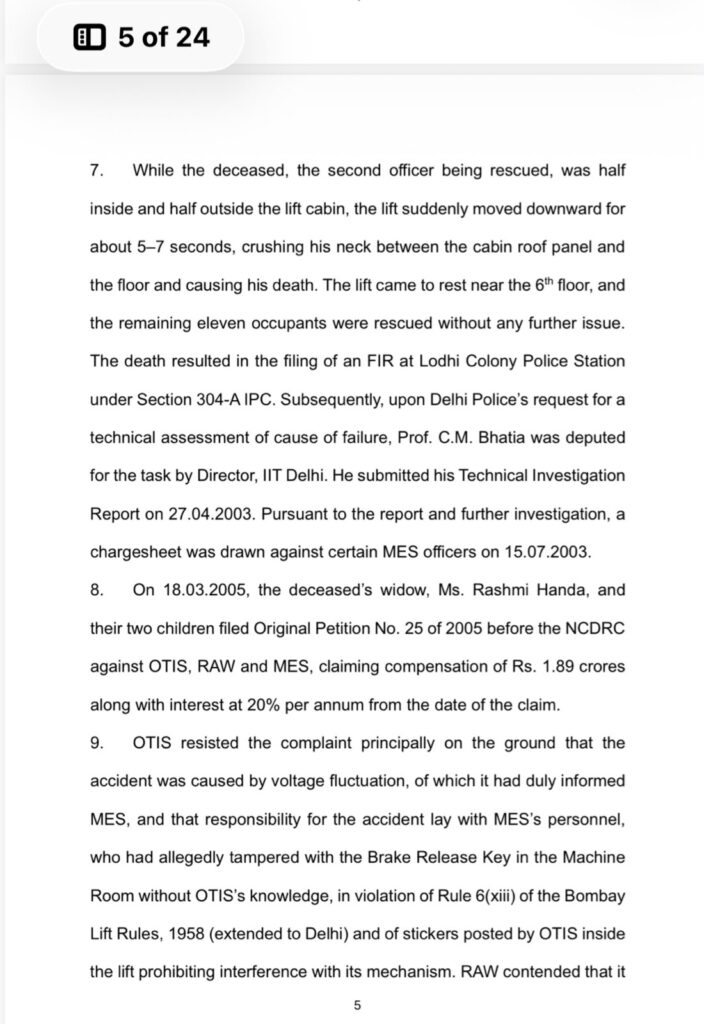
The case originated from a fatal accident on March 20, 2003, at the R&AW headquarters in New Delhi.
Vipin Handa was travelling in a lift when it stopped between floors. During the rescue operation, the lift suddenly moved while he was partly outside the elevator, resulting in his death. Other occupants were rescued safely.
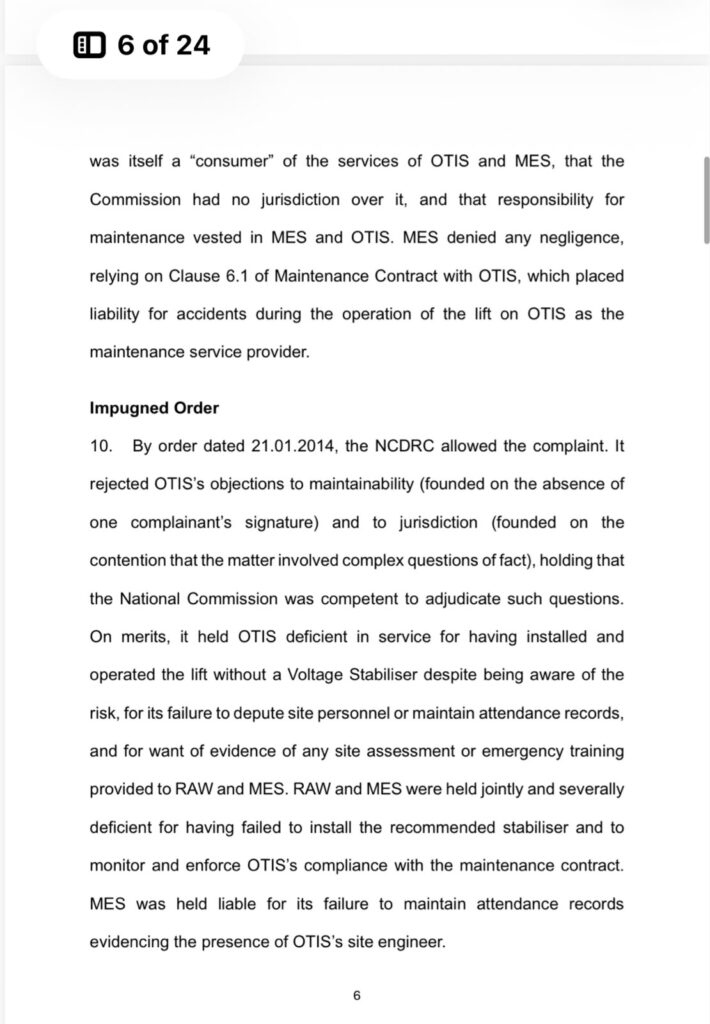
The proceedings also brought out concerns regarding the lift’s history of malfunctioning. The Supreme Court noted that repeated defects had been reported and that adequate safety measures had not been taken to prevent the risk.
Family Awarded More Than ₹3 Crore
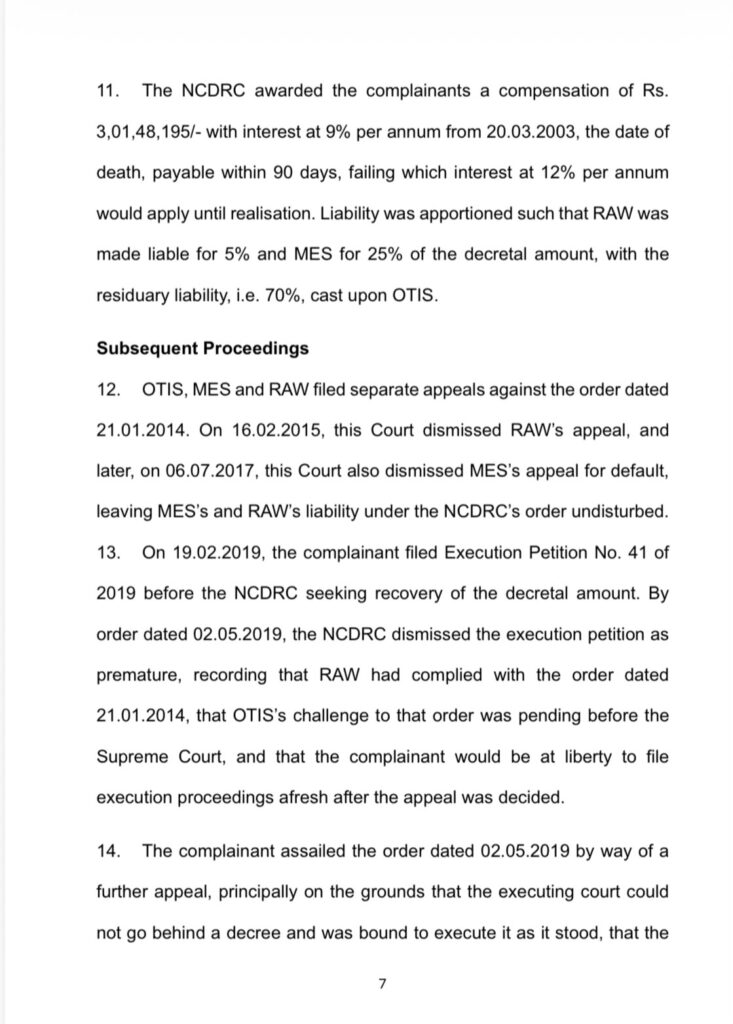
The Supreme Court upheld compensation of ₹3,01,48,195, along with interest at 9% per annum from the date of the accident. The interest rate was to increase to 12% in case of default beyond the stipulated period.
The liability was apportioned as follows:
- Otis Elevator Company – 70%
- Military Engineering Services (MES) – 25%
- R&AW/building management – 5%
The ruling brings to an end more than two decades of litigation arising from the accident.
What The Ruling Means For Housing Societies
The judgment has particular relevance for high-rise residential societies where hundreds or thousands of residents depend on lifts every day.
Apartment associations, building owners and facility-management teams should ensure that:
- Preventive maintenance is carried out at prescribed intervals.
- Complaints about jerks, unusual sounds, door problems or other abnormalities are addressed promptly.
- Maintenance and inspection records are properly maintained.
- Required safety inspections are carried out.
- A lift showing signs of serious malfunction is taken out of service until it is made safe.
- Emergency communication systems inside lifts remain functional.
- Security and maintenance personnel are properly trained to respond to lift emergencies.
The judgment also highlights the importance of taking repeated complaints seriously rather than treating them as routine maintenance issues.
What Lift Users Should Do
Residents and other lift users also need to follow basic safety precautions.
Passengers should avoid overloading a lift, should not force open its doors and should not attempt to climb out if the lift becomes stuck between floors.
In an emergency, passengers should use the alarm or emergency communication system and wait for trained personnel rather than attempting a risky rescue themselves.
Unusual jerks, noises, sudden stops, door malfunction or misalignment should immediately be reported to the building management or maintenance team.
A Significant Message For High-Rise Communities
The Supreme Court’s ruling places greater emphasis on the responsibility of everyone involved in the lifecycle of a lift — from its installation and maintenance to the management of the premises.
For residents of high-rise societies, the judgment is particularly significant because lift safety is not merely a facility-management issue. It involves the legal duty of the parties responsible for providing and maintaining the service.
The ruling also makes clear that passengers should not be left to determine which stakeholder was responsible before seeking compensation following an accident.
Note: The judgment arose from the specific facts of the Vipin Handa case. It should not be read as meaning that every lift accident automatically results in identical liability or compensation. The facts, evidence and applicable law in each case will determine responsibility.