



Last Updated:
The phenomenon targets Tesla’s reliance on an interior-facing camera positioned above the rearview mirror, which tracks head alignment and eye movement




Tesla explicitly mandates that its ‘supervised’ FSD framework does not make the vehicle autonomous, stating that a human driver must remain alert, with hands on the wheel, ready to take control at any second. Image/X
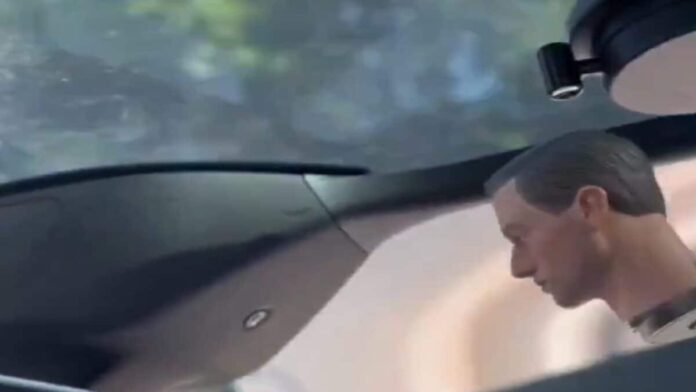
A low-tech workaround has raised fresh questions regarding the robustness of Tesla’s driver-monitoring system, with some owners reportedly using it to bypass safeguards built into the Full Self-Driving (FSD) software. Videos appearing on social media platforms show drivers placing a twenty-dollar plastic figurine head near the driver’s seat to satisfy the vehicle’s cabin camera. Proponents of the method claim it prevents the system from triggering automated attentiveness warnings, allowing motorists to look away from the road for extended intervals without the software intervening.
The phenomenon targets Tesla’s reliance on an interior-facing camera positioned above the rearview mirror, which tracks head alignment and eye movement. Introduced to reinforce driver attentiveness on Level 2 driver-assistance features, the camera is programmed to issue escalating warnings, or “nags”, and eventually disable the feature if it detects distraction. However, reports indicate that certain face-shaped figurines—including novelty celebrity items available online—can mimic basic human facial geometry closely enough to register with the optical detection software. While Tesla has not commented on this specific doll-head exploit, the automaker has historically addressed hardware-spoofing trends, such as steering wheel weights, by deploying over-the-air software updates designed to detect anomalies and lockout non-compliant users.
🚗 Une simple tête en plastique à 3 $ aurait réussi à tromper le système de surveillance du conducteur de Tesla 😭Des internautes chinois ont montré qu’une tête de mannequin vendue quelques dollars sur une plateforme similaire à Aliexpress, pouvait parfois tromper certains… pic.twitter.com/SZcWzk2OlY
— ???? ????̀???????? ???????????????? (@_3emeOeil) June 17, 2026
The viral trend has injected new complexity into the regulatory debate surrounding driver-monitoring technologies. Tesla explicitly mandates that its “supervised” FSD framework does not make the vehicle autonomous, stating that a human driver must remain alert, with hands on the wheel, ready to take control at any second. Nevertheless, safety advocates argue that the ease with which the oversight camera can seemingly be tricked underscores the limitations of relying primarily on visual data.
Automotive tech analysts note that the issue highlights a broader industry division in safety architecture. While competing manufacturers often deploy layered systems combining visual cameras with infrared eye-tracking or capacitive steering sensors, Tesla’s approach leans heavily on its camera-based vision network. Regulatory bodies in the United States and Europe, which routinely monitor autonomous and semi-autonomous driving metrics, are expected to examine how effectively vehicle software can differentiate between human operators and stationary objects. For Tesla, the situation highlights the ongoing challenge of engineering digital safety nets that resist deliberate human manipulation.
About the Author

The News Desk is a team of passionate editors and writers who break and analyse the most important events unfolding in India and abroad. From live updates to exclusive reports to in-depth explainers, …Read More
Read More