



Last Updated:
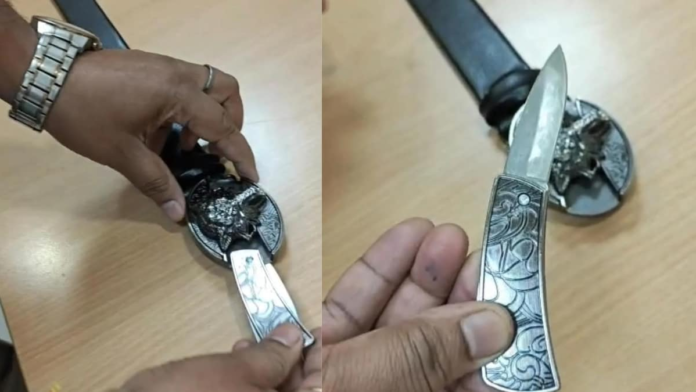
A pocket-sized knife hidden in a belt buckle slipped past the appearance of an ordinary accessory – until an X-ray scan flagged it. What else could get stopped at airport security?




Delhi Airport: The CISF shared a video of the recovery on social media, showing a pocket-sized knife concealed inside a black metallic belt buckle. (X/@CISFAirport)
Delhi News: A small knife concealed inside a belt buckle was detected by Central Industrial Security Force (CISF) personnel during security screening at Delhi’s Indira Gandhi International (IGI) Airport, officials said on Friday, November 27.
The passenger had arrived from Hong Kong and was scheduled to take a connecting flight to Raipur in Chhattisgarh when the item was detected. The CISF shared a video of the recovery on social media, showing a pocket-sized knife concealed inside a black metallic belt buckle.
According to the force, a CISF screener noticed an unusual metallic object in the baggage during X-ray screening. The bag was then referred for a physical examination, which revealed the concealed knife.
In a post on X, the CISF said the detection reflected the alertness and professional competence of its personnel. The force did not share further details about the passenger or the subsequent action taken in the case.
???????????????? ???????????????????????????? ???????????????????????????????????? ???????????????????? ???????? ???????????????? ???????????????????????? ???????? ???????????????????? ????????????????????????????!Demonstrating keen observation and professional vigilance, CISF personnel at Delhi Airport detected a concealed knife embedded in a passenger’s belt buckle during security screening.
The passenger had arrived from Hong Kong and was scheduled to travel onward to Raipur. During X-BIS image interpretation, the screener noticed an unusual metallic object and referred the baggage for physical examination, which led to the recovery of the concealed knife. The prohibited item was removed in accordance with prescribed security procedures.
The detection reflects CISF’s unwavering vigilance and commitment to maintaining robust aviation security through professional competence and alertness.
#CISF #AirportSecurity #PassengerSafety #AviationSecurity #Knife
@CISFHQrs @PIB_India @DelhiAirport
— APS – CISF (@CISFAirport) November 27, 2026
Why The Detection Matters
The incident is a reminder that airport security checks are not limited to obvious weapons. Items that appear to be ordinary personal accessories can also conceal objects that may pose a risk inside an aircraft.
A knife, even a small one, can be used as a weapon in the confined space of an aircraft cabin. This is why sharp objects are restricted in hand baggage, regardless of whether they are carried separately or concealed inside another object.
The detection also underlines the role of baggage-screening technology and physical checks. When an X-ray image shows an unusual or unclear object, security personnel may refer the bag for additional examination.
What Items Are Not Allowed In Cabin Baggage?
Passengers should check the rules before packing, as several everyday objects are prohibited in cabin baggage. The restrictions are intended to prevent items that could be used to injure passengers or crew, interfere with aircraft operations or create other safety risks.
Some commonly restricted items include:
- Knives And Sharp Objects: Pocket knives, utility knives, box cutters, razor blades, meat cleavers, pointed metal scissors, swords and similar sharp objects.
- Tools: Hammers, drills, screwdrivers, pliers, wrenches, saws, crowbars and other tools that could be used as weapons.
- Weapons And Replicas: Firearms, ammunition, air guns, realistic toy weapons, stun guns and other weapon-like objects.
- Self-Defence Items: Pepper spray, mace, tear gas, electroshock devices and similar incapacitating substances.
- Flammable And Explosive Materials: Fireworks, firecrackers, explosives, petrol, lighter fluid and several types of flammable substances.
- Certain Sporting Equipment: Cricket bats, golf clubs, hockey sticks, baseball bats, bows and arrows, and other equipment that could cause injury.
The exact restrictions can vary by item and airline. Some objects are prohibited in cabin baggage but may be carried in checked-in baggage if they are properly packed and meet applicable safety conditions.
Can Knives Be Carried In Checked-In Baggage?
In general, knives are not permitted in cabin baggage but may be carried in checked-in baggage, subject to the airline’s conditions. Air India’s published baggage guidelines, for instance, list knives of different lengths and types as prohibited in carry-on baggage but permitted in checked-in baggage.
Sharp objects placed in checked-in baggage should be securely wrapped or sheathed to prevent injuries to baggage handlers and security personnel. Passengers should also check the rules of the airline and destination country before travelling.
There are limited exceptions for certain blunt-edged items. Air India’s guidelines, for example, allow round-bladed knives, butter knives and plastic cutlery without a sharp edge in cabin baggage. These exceptions do not extend to a concealed knife such as the one detected at Delhi airport.
Are There Exceptions For Kirpans Or Other Special Items?
Some items have specific provisions. Air India’s published guidelines allow a kirpan subject to size restrictions – a blade no longer than 15.2 cm and a total length, including the handle, not exceeding 22.8 cm. However, the same guidelines state that kirpans are not allowed on international flights or on the domestic leg of an international flight.
Medical equipment and essential medicines may also be allowed under specified conditions. Passengers carrying items such as syringes, insulin supplies or other medical devices should follow airline requirements and carry supporting documentation where necessary.
These limited provisions do not create a general exemption for sharp objects. A knife hidden inside a belt buckle would not qualify as an ordinary belt accessory simply because it is small or concealed.
Other Important Baggage Rules Flyers Should Know
Sharp objects are not the only items subject to restrictions. Liquids, aerosols and gels in cabin baggage are generally subject to a 100 ml-per-container limit under the airline guidance cited below. Medicines, baby food and certain other essential items may be allowed as exceptions, subject to screening and applicable conditions.
Spare lithium batteries and power banks must generally be carried in cabin baggage rather than checked-in luggage, and they are subject to capacity and quantity limits. Air India’s guidelines, for example, permit no more than two spare batteries, including power banks, per person under the specified conditions.
Passengers should also remember that an item being allowed in checked-in baggage does not automatically mean it can be carried on board. The distinction between cabin and checked baggage is important, and security personnel may inspect or remove prohibited articles during screening.
Quick Answers
 Ask News18
A CISF screener noticed an unusual metallic object in the baggage during X-ray screening, which led to a physical examination that revealed a pocket-sized knife concealed inside a black metallic belt buckle.
Ask News18About the Author

A sociologist by training and a storyteller by profession, I spend my days shaping news, and when I’m not chasing deadlines, I’m exploring new places, discovering different cultures and tasting unique…Read More
Delhi, India, India
November 27, 2026, 13:58 IST
Read More