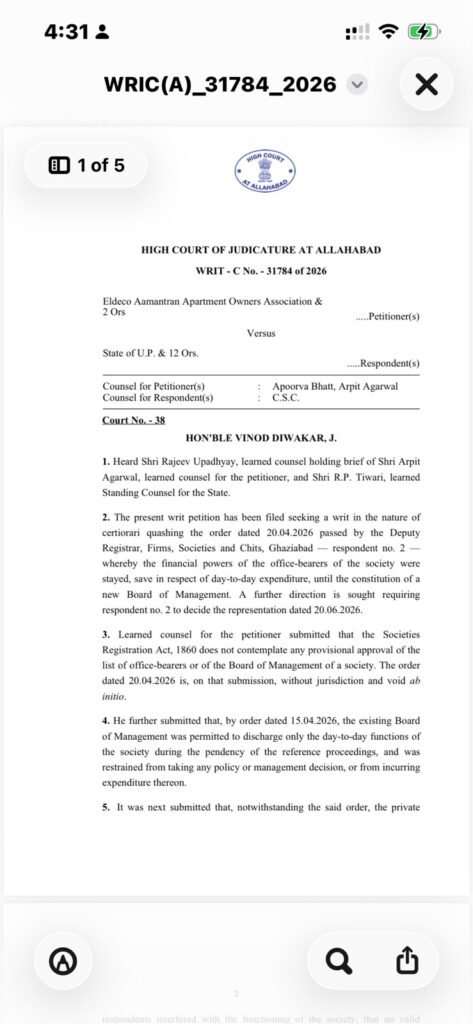
Noida: A significant order passed by the Allahabad High Court on August 12, 2026 has brought renewed focus on the legal framework governing Apartment Owners Associations (AOAs) in Uttar Pradesh. The order has implications not only for Eldeco Aamantran in Sector 119, Noida, but also potentially for apartment societies across the state, where disputes over elections, continuation of Boards, voting rights, and the powers of regulatory authorities have become recurring issues.
The petition was filed to address the perceived ambiguity between the Uttar Pradesh Apartment (Promotion of Construction, Ownership and Maintenance) Act, 2010, and the Model Bye-Laws framed thereunder, as well as questions arising from orders passed by the Deputy Registrar in apartment-society disputes.
The U.P. Apartment Act provides the statutory framework for ownership, management of common areas and formation and functioning of Associations of Apartment Owners. Section 14 specifically deals with the association and its bye-laws, while the government notified Model Bye-Laws on November 16, 2011.
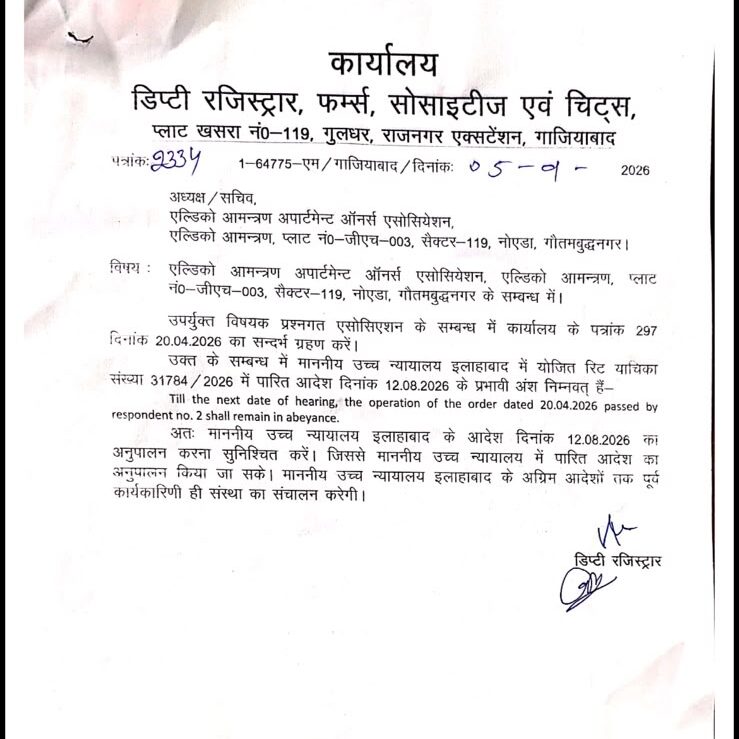
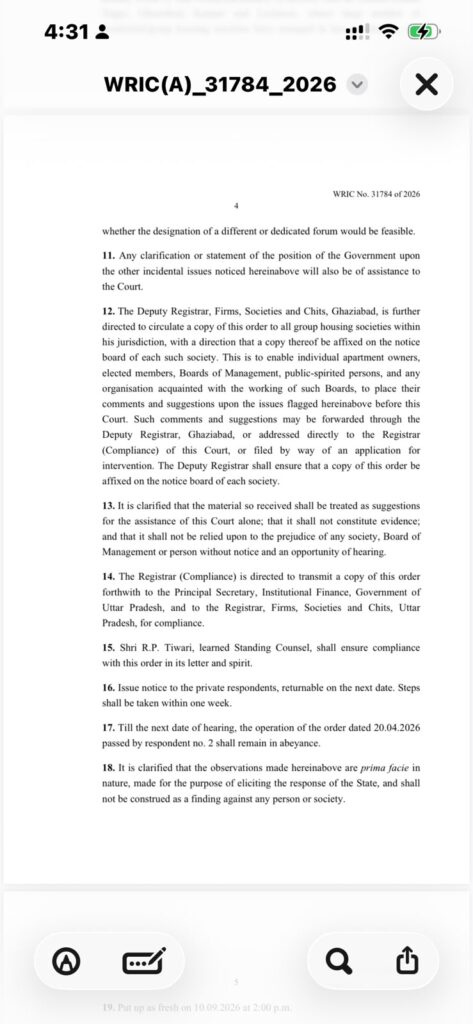
April 20 order on new board kept in abeyance
One of the immediate consequences of the High Court’s August 12 order is that the operation of the Deputy Registrar’s April 20, 2026 order has been kept in abeyance. The April 20 order had conditionally approved or registered a new Board/AOA and imposed restrictions concerning the existing office-bearers.
With that order presently kept in abeyance, the position that existed before April 20 continues for the time being. In practical terms, the AOA/Board that was managing Eldeco Aamantran before April 20 will continue to manage the society’s day-to-day affairs, subject to further orders of the High Court or the competent authority.
This is an interim position and should not be interpreted as a final adjudication on the competing claims to the Board. Eldeco Aamantran is a group-housing project in Sector 119, Noida. Public UP-RERA records list the project under registration number UPRERAPRJ1916.
Why the dispute over Bye-Law 26 is important
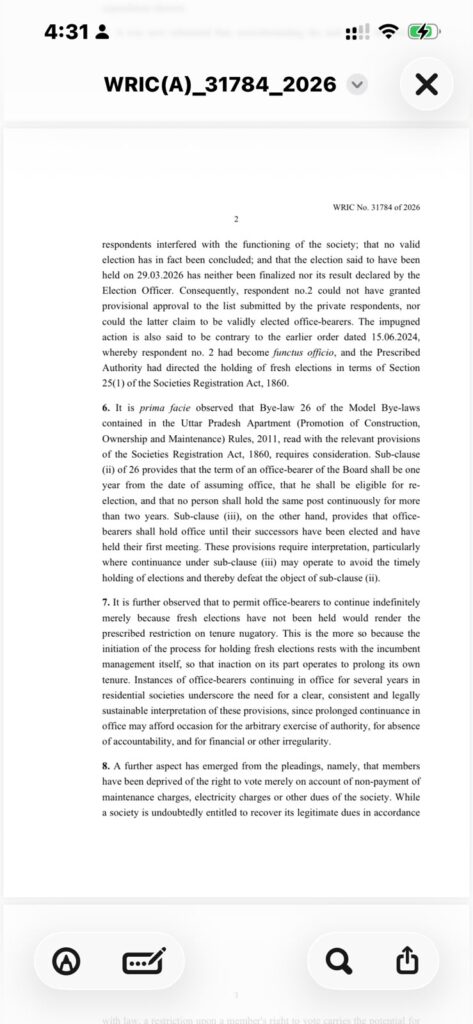
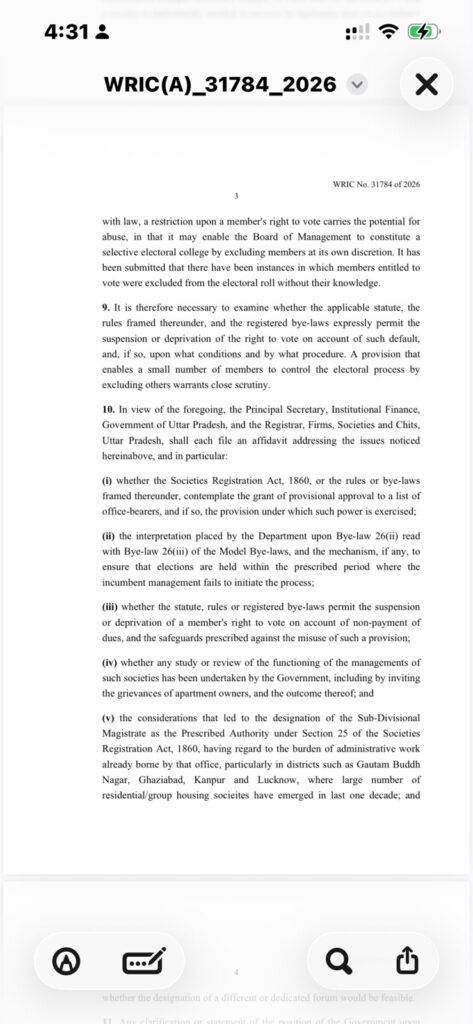
At the heart of the controversy is Clause 26 of the Model Bye-Laws, which deals with elections and the term of office.
The provision says the annual general meeting is to elect members of the Board, that the term of office of office-bearers is one year and that one-third of Board members should retire annually. It also states that office-bearers continue until their successors are elected and hold their first meeting.
The interpretation of these provisions has already generated conflicting positions in apartment-society disputes.
In Windsor Park Residents Welfare Association v. State of U.P., the Allahabad High Court in 2023 held that the statutory scheme required annual elections to all 10 posts while also requiring one-third of Board members to retire annually. The Court emphasised that elections are central to accountability and democratic functioning within an apartment association.
The issue resurfaced in Gaur Homes Apartment Owners Association v. Registrar, Firms, Societies and Chits, decided in October 2025. The Court noted the dispute over whether Clause 26(ii) meant elections should be conducted only for one-third of the posts or for all posts. Relying on the earlier Windsor Park judgment, the Court at that stage upheld the direction for elections to all 10 posts.
The August 12, 2026 proceedings therefore assume importance because the High Court has now sought to examine questions surrounding the operation of these provisions afresh in the context before it.
Can a board continue indefinitely?
One of the important questions before the Court concerns the interaction between the requirement for annual elections and the provision allowing office-bearers to remain in office until successors are elected. The provision exists to prevent a governance vacuum. However, the larger legal question is whether this continuity provision can effectively allow an existing Board to continue indefinitely if elections are repeatedly delayed.
The Court has sought clarity on this aspect, making the issue particularly relevant for apartment societies where disputes between rival groups can result in prolonged uncertainty over who is legally entitled to manage the association.
The distinction is important:
Continuity until a successor takes charge is not necessarily the same thing as an unlimited tenure.
The statutory election framework, therefore, has to be read as a whole rather than treating one clause in isolation.
Voting rights and maintenance dues under scrutiny
Another significant issue concerns the right of apartment owners to vote.
The Court has sought clarity on whether an apartment owner can be denied voting rights merely because of outstanding maintenance, electricity or other dues, and what safeguards should govern such restrictions. This question has a direct bearing on thousands of apartment owners because maintenance disputes are common in group-housing societies.
The legal framework distinguishes between membership of an apartment association and eligibility to vote. Earlier Allahabad High Court rulings have recognised that apartment ownership can confer membership while certain arrears may affect participation in elections subject to the applicable bye-law provisions. This distinction is significant because withholding voting rights can directly affect the composition of an elected Board. The Court’s examination could therefore help clarify when a financial dispute can legitimately affect an owner’s electoral rights and when it cannot.
Question over Deputy Registrar’s power
The High Court has also sought clarification from the government on the extent of the Registrar/Deputy Registrar’s powers, particularly whether the authority can provisionally or conditionally approve a list of office-bearers. This question becomes important because AOAs in Uttar Pradesh operate within an overlapping legal framework involving the U.P. Apartment Act, its Rules and Model Bye-Laws, as well as the Societies Registration Act, 1860.
The Model Bye-Laws themselves define the Registrar by reference to the Societies Registration Act.
Earlier litigation has also demonstrated how disputes involving apartment associations can bring the Deputy Registrar, Prescribed Authority and the competent authority under the Apartment Act into the same controversy. The High Court’s scrutiny of these powers could therefore help determine where the jurisdiction of one authority ends and that of another begins.
Prescribed Authority and SDM’s role also questioned
The order has also raised the issue of the continued designation of Sub-Divisional Magistrates as Prescribed Authorities under Section 25, particularly in view of their existing administrative workload. The question is whether apartment-society disputes require a more specialised and dedicated mechanism rather than being handled through an already heavily burdened administrative office.
This is not an entirely new concern. The Allahabad High Court has previously dealt with disputes involving the Deputy Registrar and Prescribed Authority in the context of apartment-association elections. In the 2023 Windsor Park judgment, the Court examined the statutory role of the Prescribed Authority under Section 25 of the Societies Registration Act in election disputes. The latest proceedings could therefore revive a broader policy discussion over whether Uttar Pradesh needs a specialised forum for apartment-society disputes.
Government asked to examine wider apartment governance issues
The High Court has also sought an explanation from the Principal Secretary and Registrar on whether the state government has undertaken any review of governance-related disputes and grievances arising in apartment societies across Uttar Pradesh. This could potentially take the matter beyond the dispute involving one society.
The state has witnessed rapid growth in group housing, particularly in the NCR districts. With thousands of apartment owners living under association-based governance structures, disputes over elections, maintenance, voting rights and control of common facilities can have a direct impact on everyday life. The U.P. Apartment Act was enacted specifically to provide a framework for apartment ownership, common areas and association management
AOAs may get an opportunity to suggest changes
Another important aspect of the proceedings is the proposed wider consultation. The order provides for circulation among group-housing societies, allowing apartment owners and other stakeholders to submit suggestions and comments.
This could give AOAs an opportunity to highlight practical difficulties they face while implementing the existing Model Bye-Laws.
Among the issues likely to attract attention are:
- Interpretation of annual election provisions
- Continuation of Boards until successors take charge
- One-third retirement provisions
- Eligibility to vote when dues are outstanding
- Preparation of electoral rolls
- Powers of the Registrar and Deputy Registrar
- Role of the Prescribed Authority
- Dispute resolution mechanisms
- Need for a dedicated apartment-society grievance forum
Why the order matters beyond Eldeco Aamantran
The significance of the August 12 order lies in the fact that many apartment associations in Uttar Pradesh function under the same statutory and bye-law framework. The Model Bye-Laws were notified under Section 14 of the 2010 Act and provide a common framework for association administration and elections.
The Allahabad High Court has previously stressed that apartment governance is intended to be democratic, with elections providing accountability to apartment owners. In Windsor Park, the Court described regular elections as an important element of accountable community governance.
At the same time, the continuing litigation shows that questions remain over how different provisions should operate together in practice. That is why the latest order could have consequences well beyond a single society.
Nikhil’s petition and residents’ response
The petitioner’s position is that the litigation was initiated to address the ambiguity between the statutory provisions and the bye-laws and to seek clarity on the legal position after what he describes as several inconsistent orders by the Deputy Registrar.
The development has received support from members of the apartment-community movement.
Kapil Mehra congratulated Nikhil and praised the initiative, saying the step required courage and that the wider community stood with him.
Dinesh Mishra, Convener, Noida HighRise Federation (NHRF) – Greater Noida, also described the order as a major development. He said the clarification of long-standing bye-law issues could benefit apartment owners across Uttar Pradesh.
Mishra particularly highlighted the Court’s consideration of suggestions from AOAs and the possibility of a dedicated special cell or forum for resolving apartment-association disputes.
He described the initiative as an important step towards moving from repeated disputes to a more structured mechanism for resolving governance issues.
What Happens Next?
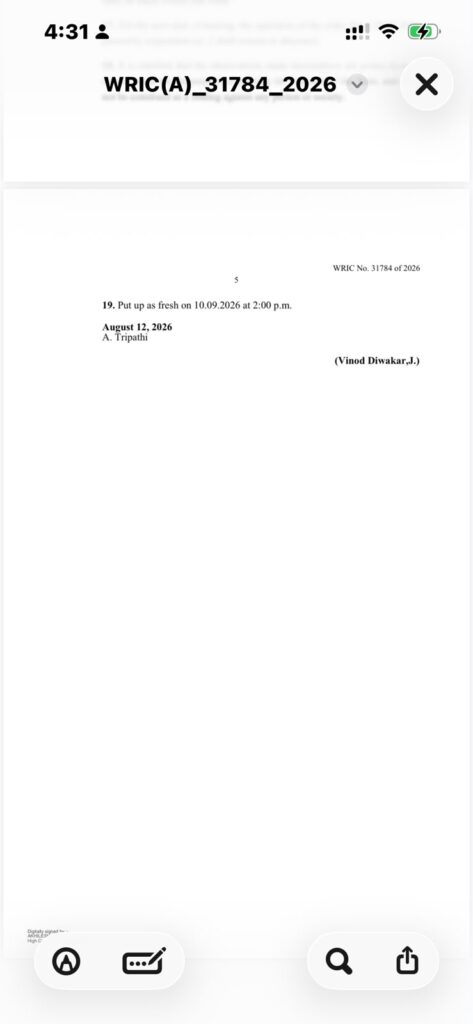
The August 12 order does not by itself finally settle every legal question raised before the Court.
Instead, several important issues have been placed under judicial scrutiny and the government has been asked to provide clarity.For Eldeco Aamantran, the immediate position is that the April 20, 2026 conditional registration/approval order remains in abeyance, leaving the earlier management arrangement in place for the time being.
For other apartment societies, the more important development is the possibility of clearer rules governing elections, voting rights, continuation of Boards and the respective powers of the Registrar and other authorities. If the proceedings ultimately result in statutory, regulatory or bye-law changes, they could significantly affect how AOAs and apartment communities across Uttar Pradesh conduct elections and resolve internal disputes.
The August 12 Allahabad High Court proceedings have brought a long-running problem in apartment governance into sharper focus: who has the authority to decide an AOA dispute, how often Boards must face elections, when an apartment owner can exercise voting rights and how long an existing Board can continue in office.
The Court’s examination of these questions could provide much-needed legal clarity for apartment owners and associations across Uttar Pradesh — provided the issues raised are ultimately settled through a final judicial determination or appropriate statutory and regulatory changes.
Following the Allahabad High Court’s order, the Deputy Registrar (DR) has now also issued a letter clarifying that the previously existing AOA of Eldeco Aamantran will continue to manage the day-to-day operations of the society. The development provides administrative clarity on the functioning of the apartment association while the issues surrounding the constitution of the new Board remain subject to further proceedings and orders.