


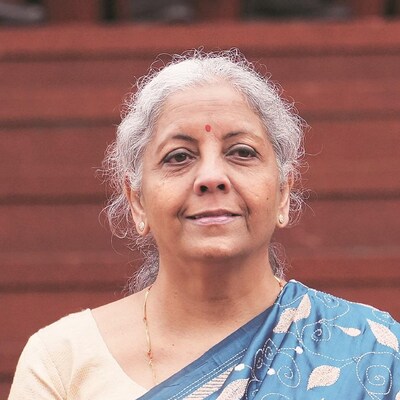

The maiden budget of the newly elected National Democratic Alliance (NDA) administration will be presented on Tuesday by Union Finance Minister Nirmala Sitharaman.
Following the BJP’s comeback to power in July 2019, Sitharaman unveiled her maiden budget.
Following the general elections, the July 23 Budget will be closely examined for coalition imperatives, electoral lessons, and
how the government chooses to allocate the enormous dividend of Rs 2.1 trillion that it received from the Reserve Bank of India, along with the fiscal space.
In laying out the overall plan, Sitharaman is still supported by the same policy team as in the few previous Budgets.
Sitharaman Nirmala
In Indian history, Sitharaman is the only finance minister to submit seven consecutive budgets, including one interim budget. She is going to surpass the record held by Morarji Desai, who presented six budgets in a row. Five budgets in a row had been presented by Manmohan Singh, Arun Jaitley, P Chidambaram, and Yashwant Sinha.
The forthcoming budget is anticipated to prioritise economic expansion and job creation while maintaining the government’s adherence to the fiscal glide path. In her speech to the joint session of Parliament, President Droupadi Murmu had declared that the Centre would implement historic changes in the Budget.
The government’s programme will prioritise the needs of the young, women, farmers, and the impoverished, according to Sitharaman and Prime Minister Narendra Modi. It is anticipated that the Budget will reveal initiatives to strengthen the social sector and rural economy.
Sitharaman, a Jawaharlal Nehru University economics graduate, oversaw military and commerce during the NDA’s 2014–19 period in office. The Balakot airstrike in Pakistan took place in 2019 when she served as the country’s defence minister.
Representing Karnataka, Sitharaman is a member of the Rajya Sabha.
Somanathan T. V.
Regarding budgetary conversations with the Prime Minister’s Office (PMO), the finance ministry’s seniorest secretary is also a crucial liaison. Experienced in creating budgets, Somanathan was appointed finance secretary in 2021 after rising to the position of expenditure secretary in the finance ministry in 2019.
Somanathan, a Tamil Nadu-bred Indian Administrative Service (IAS) officer from the 1987 batch, served in the PM’s office from April 2015 to August 2017.
The 2021–22 Budget, which discontinued the practice of borrowing money outside the Budget, was largely influenced by the bureaucracy as well. This was an attempt to increase the transparency of the central government’s balance sheets. In his role as finance secretary, Somanathan must find ways to satisfy coalition partners’ requests without sacrificing fiscal integrity.
The finance secretary holds a PhD in economics, giving her extensive knowledge of the field and publishing over 80 papers and articles. He is the author of two books. In addition, Somanathan held deputation positions as director at the World Bank in Washington, DC, and joint secretary in the Ministry of Corporate Affairs.
Seth Ajay
Seth is the secretary of the Department of Economic Affairs. He is an IAS officer from the Karnataka cadre, having joined in 1987. He is a key player in the creation of the budget, helping to design the budget documents and coordinating requests for funds across ministries.
Managing director of Bangalore Metro Rail Corporation, Seth is also recognised for spearheading projects like the establishment of the Infrastructure Finance Secretariat and the country’s first sovereign green bond issue.
Tuhin Kanta Pandey
Pandey is in charge of deciding on the goals for disinvestment and resource mobilisation through dividends from public-sector businesses in her capacity as secretary of the Department of Investment and Public Asset Management (Dipam). A distinct disinvestment target was eliminated by the government from the February-presented Interim Budget for FY25. Instead, it has combined under the heading of “miscellaneous capital receipts” receipts from disinvestment, asset monetisation, and other capital receipts not otherwise designated.
Pandey, an Odisha cadre IAS from the 1987 batch, is known for having finalised the long-awaited sale of Air India and for having played a key role in the launch of the Life Insurance Corporation of India.
Considering the coalition partner’s role in the process, this budget is anticipated to provide some indications regarding government plans for privatisation. This year marks the completion of the process that was started two years ago to sell the government’s share of IDBI Bank.
Malhotra Sanjay
In his capacity as revenue secretary, Malhotra determines goals for revenue receipts and makes decisions regarding direct and indirect tax adjustments, particularly those involving the Finance Bill.
Malhotra, an IAS officer from the Rajasthan cadre who was born in 1990, has adopted a cautious stance when establishing revenue goals.
Malhotra is in charge of designing a revenue-neutral tax system and is crucial in bringing the interests of the Centre and the states together at Goods and Services Tax (GST) Council meetings.
Joshi Vivek
One of the most recent additions to the finance minister’s budget team is Vivek Joshi, who began working for the ministry in November 2022 as the secretary of the Department of Financial Services, which is in charge of formulating policy reforms for the banking, insurance, and pension sectors.
Joshi, a Haryana cadre officer from the 1989 class, is anticipated to forward the long-overdue changes to the insurance law. It’s unlikely that the plan to sell off one general insurance company and two public banks will advance very far.
Joshi graduated from the University of Geneva with a doctorate in international economics. Joshi served as India’s census commissioner and registrar general before to being named financial services secretary.
Vageswaran Anantha
In his capacity as chief economic advisor (CEA), Nageswaran establishes the national and international macroeconomic framework that guides the formulation of the budget speech and the setting of the budget targets.
The Economic Survey is written by the CEA and his group of economists, and it is released the day before the budget. Analysts frequently attempt to infer from the Survey the expected tone of the Budget. Now that the broad macro figures are accessible to the public, the Survey for FY24 will be able to analyse the economic trends from the previous financial year in great detail.
Nageswaran, who assumed leadership in 2022, is an MBA graduate of Ahmedabad’s Indian Institute of Management and a PhD candidate at UMass Amherst’s Isenberg School of Management.