


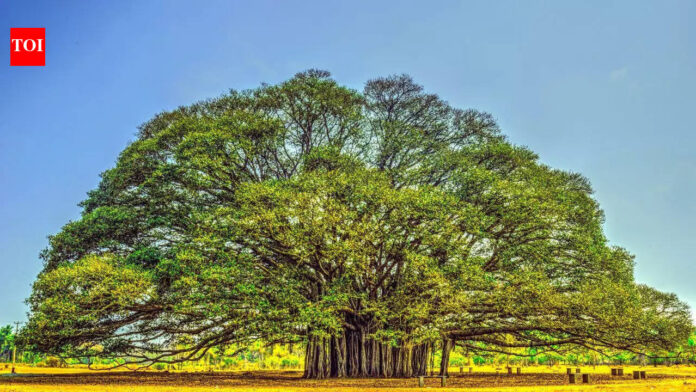

Trees have always been a part of human civilization, and their uses range from providing protection, food, shade, and a source of life in the form of oxygen to many other things. Among the innumerable species of trees that scatter the world, only one species will be highlighted for the virtues of size, endurance, and significance, and that species is the “Banyan Tree,” scientifically known as Ficus benghalensis, and it is widely regarded as the “King of Trees.”The Banyan Tree symbolises strength, unity, and resistance. Just as the Banyan Tree provides shelter to hundreds of species in its shade, it also symbolizes the concept of shelter or protection in the human system. The fact that the tree has the strength to survive for so long is another reason for it to symbolise the concept of having more wisdom.
Why the banyan tree is called the king of trees and how it grows
Because of its vast canopy, huge sprawling roots, and the self-sustaining faculties it provides for scores of living organisms, the Banyan Tree is accorded the title of King of Trees. In contrast to ordinary trees, its branches form aerial roots that grow downwards and anchor in the soil to form secondary trunks. The result is that one tree can extend over a very wide area, often seeming like a small forest. Its imposing aspect and sheltering shade have made it a symbol of permanence, strength, and shelter.The Banyan Tree has one of the most interesting growth patterns in the plant kingdom. It has big aerial roots. The aerial roots grow from the branches toward the ground and, over time, thicken into new trunks that support the weight of the canopy above it. This allows the tree, over a period of time, to spread both horizontally and vertically over large areas of land. Not only does this spread make the tree stronger structurally, but it also makes it capable of surviving for hundreds of years. The potential for indefinite expansion has made the Banyan a symbol of eternal life in many cultures.
The banyan tree’s longevity and vital role in supporting ecosystems
One of the most astonishing characteristics of the Banyan Tree is its long life. It has been observed in many cases of the Banyan Tree that the trees normally live for several hundred years, and in some cases in India, the ancient Banyan Trees have been estimated to be more than two hundred years old. For example, the Great Banyan Tree in Howrah, West Bengal, spanning more than three acres, is still alive and flourishing despite being so old. In itself, the long life of the Banyan Tree marks longevity, strength, and stamina, justifying its title as the “king.”In addition to the remarkable size and life span, the Banyan Tree is of equal importance to the ecosystem it grows in. With a sprawling canopy, the tree forms a micro-ecosystem, with a cooling effect on the environment, shielding humans, animals, and other plants in the vicinity from the scorching sun. The figs that grow on the tree are a source of food to a number of birds, bats, insects, and other wildlife, sustaining life in the ecosystem. Birds and smaller mammals make their habitats in the aerial roots and trunks of the trees, forming a rich ecosystem around a single tree.
Cultural and spiritual importance of the ‘king of trees’
It is, particularly in Indian culture, something well beyond the boundaries of nature’s wonder; it is an emblem of knowledge, longevity, and safeguarding. There exist several legends and stories in Indian mythology that link the Banyan tree with godliness and eternal life. It is common to depict it in illustrations as “the holy tree under which saints sit in meditation and where people assemble.” The wide shade created by the tree is, in fact, the gathering place in Indian villages to rest, listen to stories, and hold local discussions. Being declared the “National Tree of India” is an emblem of its significance.
Banyan tree distribution and habitat
Banyan Tree is native to the Indian subcontinent, which includes India, Sri Lanka, Nepal, and Bangladesh. Banyan Tree grows in tropical, subtropical, and other regions, which include the roadside, villages, temple sites, and open land. The fact that the Banyan Tree grows in a populated area indicates the significance of the Banyan Tree in the lives of the population. This is because Banyan Tree serves as a source of shade, shelter, and a gathering place.Banyan Tree is a biological fortress with various species of life existing in relation to it. The fruits from the tree act as food for birds as well as insects, while its root system provides a site for rest for animals such as small mammals. The tree provides shelter for both monkeys and squirrels; therefore, it is a hub of activities. Based on this, it can be observed that the Banyan Tree is a lifeline for species, with evidence of dependency on species and plants.