


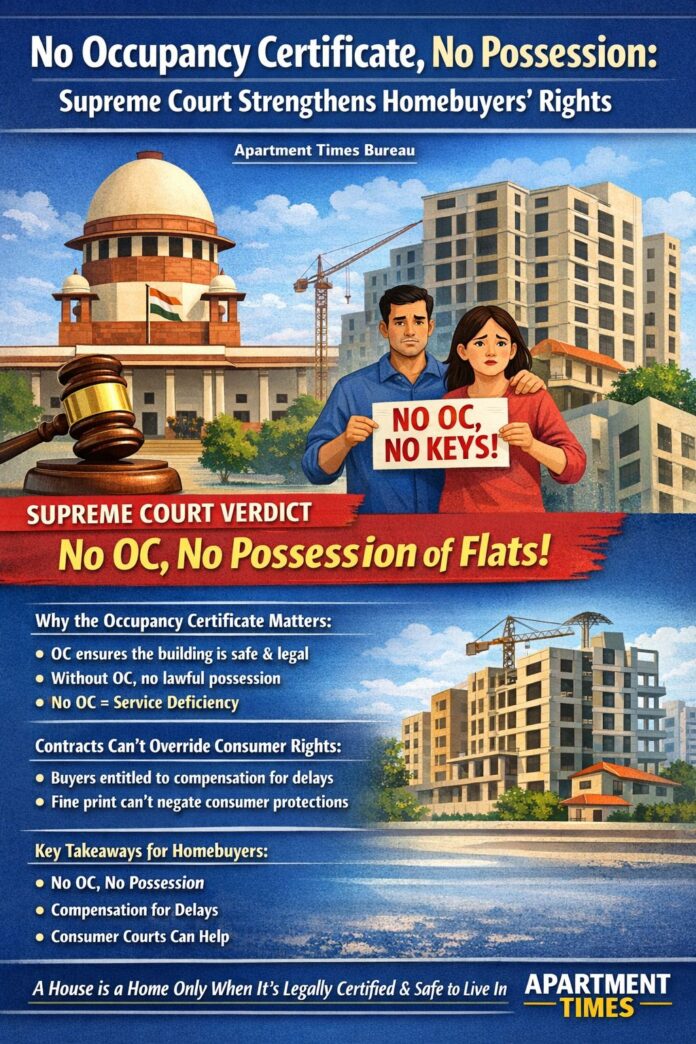

NOIDA : No Occupancy Certificate, No Possession: Supreme Court Strengthens Homebuyers’ RightsApartment Times Bureau In a landmark ruling that brings relief to thousands of flat buyers across the country, the Supreme Court of India has made it clear a homebuyer cannot be compelled to accept possession of a flat without a valid Occupancy Certificate (OC).
The judgment reinforces a principle that many buyers have long argued — possession is not just about handing over keys; it is about handing over a legally compliant, habitable home.
The Case That Sparked the Ruling
The decision came in a dispute involving Parsvnath Developers Ltd. and homebuyers of the residential project Parsvnath Exotica in Gurugram.
Buyers had booked flats between 2007 and 2011, paying substantial amounts with the promise of timely delivery. However, despite the lapse of the committed possession period, the project did not receive the mandatory Occupancy Certificate from the competent authority. Instead, the developer attempted to offer possession on an “as is where is” basis.
The buyers approached the National Consumer Disputes Redressal Commission, which ruled in their favour. The Commission directed the builder to complete the project, obtain the OC, hand over lawful possession, and compensate buyers for the delay.
The developer challenged the order before the apex court — but the Supreme Court upheld the consumer forum’s decision.
Why the Occupancy Certificate Matters
An Occupancy Certificate is issued by local authorities only after confirming that the building complies with sanctioned plans, safety norms, structural requirements, and civic infrastructure standards.
Without it:
The building is not officially declared fit for occupation.
Basic services such as water, electricity, and sewer connections may face complications.
Buyers may encounter legal hurdles during resale or loan processing.
The Court observed that offering possession without obtaining the OC amounts to deficiency in service under the Consumer Protection Act (now replaced by the 2019 Act). Simply put, a buyer cannot be forced to take possession of a home that lacks statutory approval.
Contracts Cannot Override Consumer Rights
A significant aspect of the ruling is the Court’s position that contractual clauses limiting compensation or liability cannot override statutory consumer rights.
Developers often rely on fine-print clauses to restrict compensation for delay. However, the Supreme Court clarified that consumer forums have the authority to award fair compensation where there is clear delay or non-compliance — regardless of what the builder-buyer agreement states.
This sends a strong message: statutory compliance is not optional, and contractual technicalities cannot dilute consumer protection.
What This Means for Flat Buyers
For residents and prospective buyers in NCR and beyond, the ruling carries practical importance:
Buyers are not legally bound to accept possession without an OC.
Delays due to non-compliance can entitle buyers to compensation.
Consumer courts remain a strong avenue for redressal.
Developers must complete all approvals before handing over homes.
A Step Towards Accountability
In cities like Noida, Greater Noida, Gurugram, and other rapidly developing corridors, delayed possession and incomplete approvals have been recurring concerns. This ruling reinforces accountability in the real estate sector and strengthens confidence among homebuyers.
For many families who invest life savings into their dream homes, the judgment affirms a simple yet powerful principle:
A house becomes a home only when it is legally safe, structurally compliant, and officially approved for occupation.
Apartment Times will continue to track key legal developments impacting apartment owners and homebuyers across the country.