


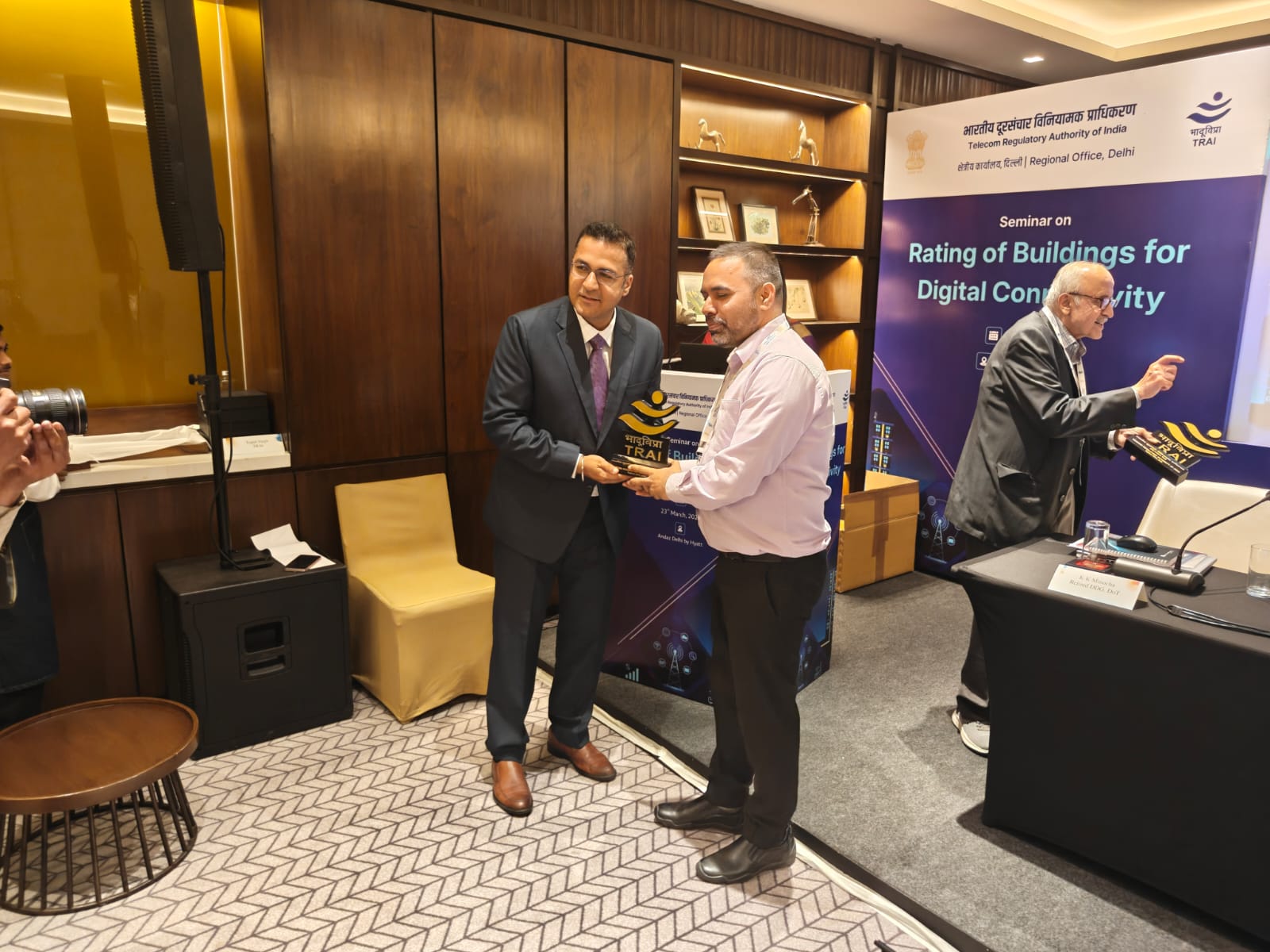
Greater Noida West: In an era of rapid urbanisation where high-rise buildings define modern India, a critical basic need continues to be overlooked, digital connectivity. Representing the concerns of lakhs of residents, the NEFOWA Foundation has now brought this issue directly into the policy and safety framework at the national level.
During a seminar organised by the Telecom Regulatory Authority of India, the foundation presented a detailed report, asserting that internet and mobile networks can no longer be treated as optional conveniences but must be recognised as essential urban infrastructure.
Representation at National platform
The seminar, held under the guidance of the Government of India, saw participation from NEFOWA representatives Dinkar Pandey, Dipankar Kumar and Rahul Yadav. Their presentation highlighted the growing gap between urban infrastructure development and digital readiness in residential complexes.
Residents today depend on stable connectivity not just for communication, but for work-from-home setups, online education, digital payments and telemedicine. When a building fails to provide consistent network access, it directly impacts productivity, safety and quality of life.
Dinker Pandey, Active member of Nefowa, Resident of Ajnara Homes, GNW

Faraday cage effect: a hidden urban risk
A key concern raised in the report was the “Faraday Cage Effect”, a phenomenon where modern glass and steel structures block or weaken mobile signals. As a result, residents in high-rise societies often face poor connectivity on upper floors, complete signal loss in basements and lifts, and network congestion due to high population density.
Dipankar Kumar elaborated that this issue is becoming more severe with the rise of energy-efficient buildings that use reflective materials.
While these designs are environmentally efficient, they unintentionally disrupt signal penetration. Without planned digital infrastructure, these buildings become communication dead zones.
Dipanker Kumar, Active member of Nefowa, Resident of Panchsheel Greens, GNW
Call for accountability and standardisation
Speaking on the issue, NEFOWA stressed that in the absence of clear standards and accountability, developers continue to provide incomplete and inconsistent digital infrastructure across buildings.
Rahul Yadav added that residents are often forced to rely on a single service provider due to exclusive agreements between builders and telecom companies.
This creates a monopoly-like situation where service quality suffers and consumers have no real choice. Broadband portability must be ensured just like mobile number portability.
Rahul Yadav, Raksha Adella, Active Member of Nefowa, Resident of Raksha Adella, Gaur City
Key demands by NEFOWA
- Mandatory Digital NOC: Just like fire and environmental clearances, every building must obtain a digital connectivity No Objection Certificate before occupancy certification.
- Pre-construction digital planning: Network infrastructure should be integrated at the design stage to avoid costly retrofitting later.
- 100% connectivity in lifts and basements: These areas should follow a strict pass-or-fail benchmark. Lack of signal here should mean failure of the entire building’s compliance.
- Multi-operator system: At least three service providers should be available in every building to ensure competition, choice and service quality.
- Adoption of global standards: India must align its digital infrastructure norms with international best practices.
- BMS and AI-based monitoring: Integration of network systems with building management systems for real-time monitoring and automatic failover mechanisms.
Connectivity as a safety necessity
NEFOWA strongly highlighted the role of connectivity during emergencies. Situations such as being trapped in a lift without signal or communication failure during a basement fire are not just technical lapses but systemic failures that need urgent correction.
Experts also point out that emergency services increasingly rely on digital communication systems. Without reliable connectivity, response time can be severely impacted, further escalating risks.
Policy message: warning and opportunity
The report serves both as a warning and an opportunity for policymakers. Frameworks like the TRAI 2024 proposals must move beyond documentation and be implemented on the ground.
Industry observers believe that if these recommendations are adopted, they could set a new benchmark for smart city infrastructure across India. However, delay in implementation could deepen the crisis, making future solutions more complex and expensive.
A new pillar of urban infrastructure
In today’s digital age, connectivity has become as essential as water, electricity and roads. NEFOWA’s initiative not only addresses the immediate concerns of residents but also pushes for a structural shift in how urban development is planned in India.
As stakeholders await action from authorities, one thing is clear, the conversation around urban infrastructure is evolving. And at the centre of it is a simple but urgent demand: uninterrupted, reliable digital connectivity for every resident.
- Digital connectivity under spotlight: NEFOWA demands mandatory digital NOC, broadband portability in urban housing
 Greater Noida West: In an era of rapid urbanisation where high-rise buildings define modern India,… Read more: Digital connectivity under spotlight: NEFOWA demands mandatory digital NOC, broadband portability in urban housing
 - World Tuberculosis Day: Social initiative in Noida sees five TB patients adopted, Nutrition kits distributed
 The campaign is a collaborative effort by the Uttar Pradesh Health Department, SMART NGO, and Radio Amity 107.8 FM, aimed at strengthening public health awareness and support for tuberculosis patients.
 - Air China To Resume Direct Flights Between Beijing, New Delhi | World News
 Last Updated:March 21, 2026, 15:42 IST Air China to resume direct Beijing New Delhi flights,… Read more: Air China To Resume Direct Flights Between Beijing, New Delhi | World News
 - Man dies, woman injured as auto-rickshaw overturns over in Noida
 A 40-year-old man died and a woman was injured after the driver of the shared… Read more: Man dies, woman injured as auto-rickshaw overturns over in Noida
 - Symptoms of Pituitary Tumors – NCISigns of a pituitary tumor include problems with vision and certain physical changes. Signs and… Read more: Symptoms of Pituitary Tumors – NCI
- La Residentia : Protest intensifies with bhajan, ‘work from protest’ and community-led activities
 Greater Noida West : The ongoing protest by residents of La Residentia has entered multiple… Read more: La Residentia : Protest intensifies with bhajan, ‘work from protest’ and community-led activities
 - Inside Azim Premji’s ₹350 crore minimalist home in Bengaluru
 One of the unique features of the house is the dual facade design of the… Read more: Inside Azim Premji’s ₹350 crore minimalist home in Bengaluru
 - Assotech Windsor Court : Free health check-up camp successfully organised for the betterment of the residents
 Noida : A free health check-up camp was successfully organised at Assotech Windsor Court on… Read more: Assotech Windsor Court : Free health check-up camp successfully organised for the betterment of the residents
 - Greater Noida West To Get Traffic Relief, Two New U-Turns Likely By July
 Greater Noida West : Residents of Greater Noida West can expect major relief from daily… Read more: Greater Noida West To Get Traffic Relief, Two New U-Turns Likely By July
 - Atal Swaranjali celebrates the legacy of Atal Bihari Vajpayee at Talkatora Indoor Stadium
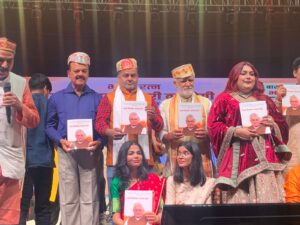 Noida: A grand cultural programme titled “Atal Swaranjali” was organised at Talkatora Indoor Stadium by… Read more: Atal Swaranjali celebrates the legacy of Atal Bihari Vajpayee at Talkatora Indoor Stadium
 - Gulshan Group ties up with Indian Hotels Company Limited to bring the Taj hotel and branded residences to Noida
 Noida: In a major boost to the city’s luxury real estate and hospitality landscape, the… Read more: Gulshan Group ties up with Indian Hotels Company Limited to bring the Taj hotel and branded residences to Noida
 - Mahagunpuram: Man jumps from 13th floor, Mother found dead inside flat, Probe underway
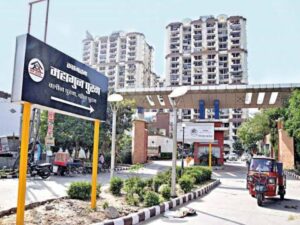 Ghaziabad : A shocking incident has sent panic across the Mahagunpuram society in Ghaziabad, where… Read more: Mahagunpuram: Man jumps from 13th floor, Mother found dead inside flat, Probe underway