


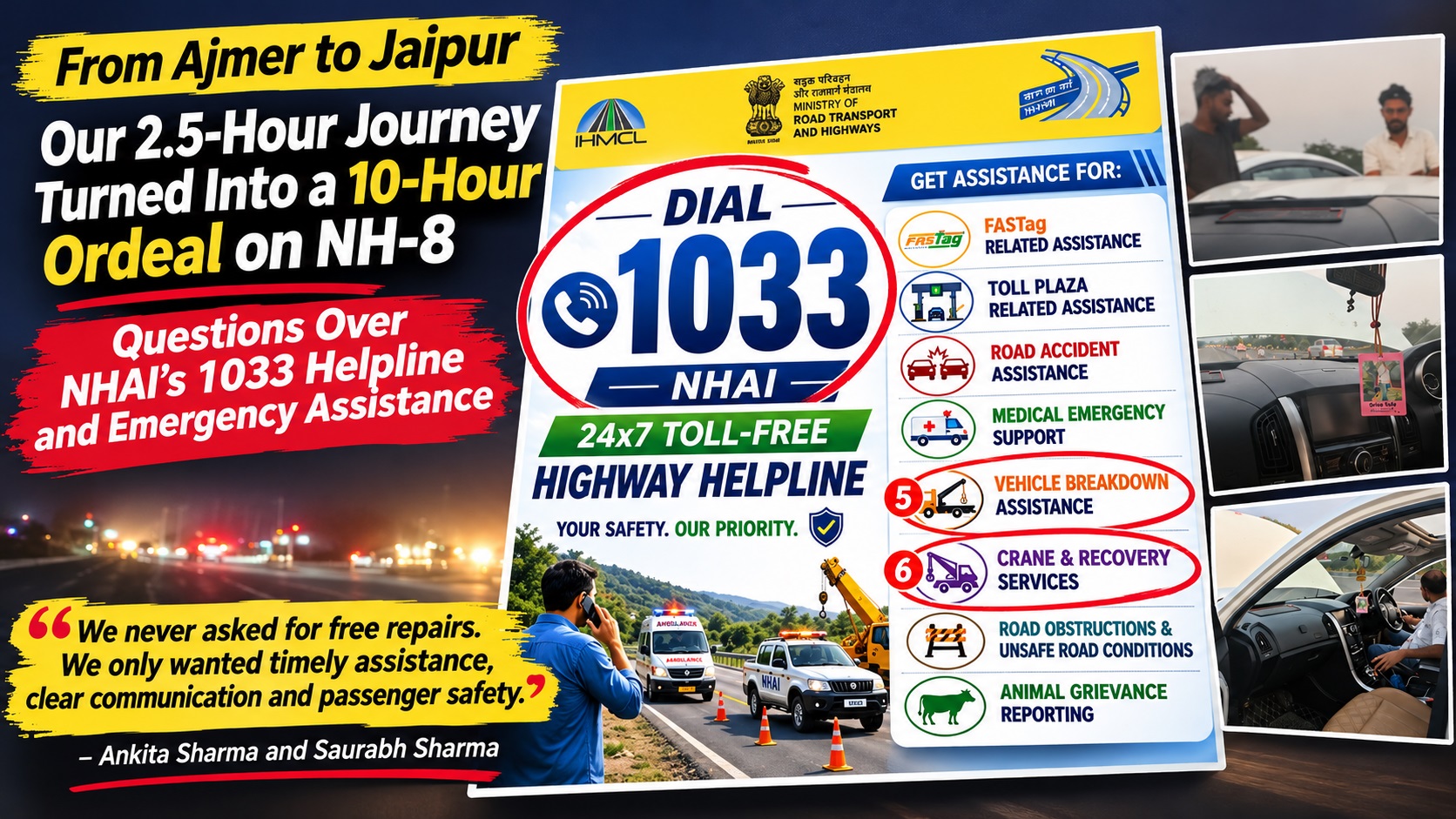
Jaipur : What was supposed to be a routine two- to two-and-a-half-hour journey from Ajmer to Jaipur turned into nearly 10 hours of uncertainty, exhaustion and distress for us on November 15.
My husband, Saurabh Sharma and I, Ankita Sharma, were travelling with our two children, aged 2 and 11. We left Ajmer at around 1 pm, expecting to reach Jaipur by approximately 3:30 pm. However, around 3 pm, our vehicle started developing technical problems on National Highway-8 (NH-8).
The car repeatedly broke down. It would restart temporarily, travel barely a few kilometres and then stop again. This happened three times, leaving us stranded on the highway.
Initially, we remained hopeful that the problem would be resolved quickly. Between 3 pm and 4 pm, we continued trying to get the vehicle moving and manage the situation. We repeatedly contacted NHAI’s 1033 helpline while simultaneously exploring other ways to arrange assistance.
What we had expected to be a short road journey was gradually turning into an ordeal that neither we nor our children were prepared for.
Repeated calls to 1033 and follow-ups with PR officials
When it became clear that the situation was not getting resolved, we decided to record our first video highlighting what we were going through. We continued making calls to the helpline and searching for local mechanics through Google.
We also spoke to NHAI’s PR officials, who informed us that they were trying to connect with senior officials. They also made efforts to help us and coordinate assistance.
We acknowledge these efforts and do not deny that the PR representatives attempted to intervene. However, despite these communications, our immediate problem remained unresolved. We were still stranded, and the vehicle continued to malfunction.
Our concern was not simply about getting someone to move the vehicle off the main carriageway. We needed a practical solution that would allow us to continue our journey safely or get the vehicle recovered to a proper workshop.
We were repeatedly seeking help because the situation was becoming increasingly difficult, particularly with two children travelling with us.
Local mechanics tried repeatedly, but the vehicle kept breaking down
Eventually, local mechanics reached our location, giving us hope that the problem might finally be resolved.
They managed to start the vehicle, but it would run for barely a minute or cover a short distance before stopping again. We paid the mechanics for their services. After attempting to resolve the issue, they left, but the problem persisted.
This cycle repeated itself. The vehicle would restart temporarily, only to break down again. Eventually, it stopped starting altogether.
We are not questioning the efforts made by the local mechanics. They were trying their best within the limitations of roadside repairs. However, it had become evident that the vehicle was facing a more serious technical problem that required proper diagnosis and attention at a workshop.
At that point, repeated roadside attempts were clearly not providing a lasting solution.
NHAI’s 1033 helpline clarifies that its crane only moves vehicles to the roadside
During our communication with NHAI, we were reportedly informed that its crane service could only move a vehicle from the main carriageway to the roadside and would not tow it to a workshop.
This raised an important question for us: if the available crane service is limited to shifting a vehicle from the main carriageway to the roadside, what happens to passengers who remain stranded and need further assistance?
We were already prepared to hire a private towing crane. The crane was being arranged from Jaipur and was expected to take considerable time to reach our location.
Meanwhile, we continued seeking assistance from NHAI in the hope that some quicker help or an alternative arrangement could be provided. Our appeal was genuine. We were not refusing to arrange a private service. We were simply trying to explore whether a faster solution could be facilitated while the private crane was on its way.
Eventually, after exhausting the available options, we went ahead with the private crane service.
Two young children, hunger, thirst and no access to basic facilities
As the hours passed, the situation became increasingly difficult for our family.
We had two children travelling with us, one aged 2 and the other 11. We had planned for a journey of barely a few hours and had carried food and water accordingly.
As the wait stretched on, we became hungry and thirsty. We had no access to proper washroom facilities, and even managing basic necessities became difficult.
Caring for a two-year-old child in such circumstances was particularly challenging. Our younger child is bottle-fed, which meant we also had to manage the additional requirements of feeding and caring for a toddler while remaining stranded on the highway.
Our 11-year-old child was also travelling with us and had to endure the prolonged uncertainty and discomfort.
We were not merely waiting for a mechanic or a towing vehicle. We were trying to manage the needs of four people, including two children, while stranded on a national highway for hours.
The physical exhaustion eventually became overwhelming for me. I reached a point where I felt I might faint.
Every passing hour added to our distress. What made the situation more difficult was the uncertainty about when we would finally be able to leave the location.
A genuine offer of help from an NHAI helpline representative, but why not tow the vehicle to the nearest service station?
Amid the prolonged ordeal, there was one instance of genuine assistance from an NHAI helpline representative that we believe deserves acknowledgement.
During one of the calls, when the situation had become physically overwhelming at approximately 8 pm, I told the helpline representative that I could no longer continue taking calls as I was feeling extremely weak and was on the verge of fainting.
Understanding my condition, the representative offered to arrange a vehicle to pick us up and take us to the nearest hotel so that we could access a washroom, freshen up and have some refreshments.
We genuinely appreciate this thoughtful gesture, particularly considering the difficult circumstances we were facing.
However, it also left us with an important question.
If a vehicle could be arranged to transport stranded passengers to a nearby hotel for basic facilities and refreshments, why could similar coordination not be explored for recovering the broken-down vehicle to the nearest suitable service station or workshop?
We were not insisting that the vehicle be towed all the way to Jaipur, nor were we demanding free mechanical repairs. We simply wanted the vehicle to reach the nearest appropriate service station so that its actual technical problem could be diagnosed and resolved.
We appreciate the helpline representative’s offer, but we would also like to understand why similar coordination could not be extended to vehicle recovery.
There were practical reasons why we could not simply leave the vehicle behind and take a ride to a nearby hotel. Our car was loaded with luggage and personal belongings and leaving it unattended on the highway was not a feasible option. Moreover, the location where our vehicle had broken down had become extremely dark as evening progressed. Given the security concerns, my husband could not leave our two children and me alone at an isolated stretch of the highway while taking the vehicle elsewhere or arranging alternative transport. Our safety as passengers and the security of our belongings were equally important concerns.
Under these circumstances, arranging transport for the passengers alone would not have resolved our immediate problem. We needed a coordinated solution that addressed both passenger safety and vehicle recovery. We were not asking for the vehicle to be towed all the way to Jaipur or demanding free mechanical repairs. We simply wanted it to be taken to the nearest suitable service station so that the actual technical problem could be diagnosed and resolved.
We never asked for free repairs: Insurance and RSA are not the issue
As our experience gained attention on social media, several responses questioned why we expected free assistance from NHAI, whether our vehicle was insured and why we had not contacted a private roadside assistance (RSA) provider.
We believe these discussions miss the actual concern.
At no point did we demand free vehicle repairs or insist that NHAI provide a mechanic at its expense. We were willing to pay for services and actually explored paid options, including local mechanics and a private towing crane.
We also contacted the official 1033 helpline because it is the designated emergency assistance channel for National Highway users.
We tried every possible route, from contacting the official helpline to independently arranging paid services, because getting ourselves and our children out of the situation safely was our immediate priority.
Whether the vehicle was old, insured or properly serviced is a separate discussion. Why we did not contact a particular private RSA provider is also a separate matter.
None of these questions answers what happened when we contacted the official emergency helpline and remained stranded for hours.
We were not asking NHAI to take responsibility for the mechanical condition of our vehicle. We were asking for timely emergency assistance, clear communication and support in ensuring passenger safety.
Rajmarg Yatra promises emergency assistance: What happens when commuters actually need it?
The National Highways Authority of India’s Rajmarg Yatra application is presented as a citizen-centric initiative designed to make travel on Indian National Highways safer, smarter and more convenient.
Its stated features include road safety alerts, voice assistance and emergency assistance. The emergency assistance framework refers to coordination with ambulances, highway patrol vehicles and cranes for accident victims and vehicle recovery. The 1033 helpline provides a toll-free channel through which highway users can seek assistance.
These stated objectives raise an important question about the gap between the assistance promised to commuters and what they experience on the ground.
When we contacted the official emergency helpline after our vehicle broke down, we expected our complaint to lead to an appropriate and timely response.
However, according to our experience, repeated calls and follow-ups did not result in effective vehicle recovery at our location. Instead, we had to independently search for mechanics, arrange private towing and manage the situation while attending to our two young children.
We would like NHAI to clarify what assistance a stranded motorist can actually expect through the 1033 helpline in a vehicle breakdown situation.
Vehicle repair and emergency assistance are two different things
The distinction between vehicle repair and emergency assistance needs to be clearly understood.
We were not asking NHAI to provide a free mechanic or undertake vehicle repairs at its expense. We were seeking timely emergency response, assistance in ensuring passenger safety and clear guidance on vehicle recovery.
Even if mechanical repairs are outside the scope of NHAI’s services, that does not remove the need for an effective response to stranded passengers.
A broken-down vehicle on a national highway can pose a safety risk not only to its occupants but also to other motorists. The immediate priority should be to ensure that passengers, particularly children and vulnerable travellers, are not left in a difficult or potentially unsafe situation for hours.
We also question why the available assistance could not facilitate the vehicle’s recovery to a suitable workshop when repeated roadside repair attempts had failed.
We understand that NHAI may have defined operational limitations. However, commuters should be clearly informed about those limitations and guided towards the appropriate assistance instead of being left uncertain about what to do next.
Questions NHAI and the Ministry must answer
Our experience raises several questions about the effectiveness of NHAI’s 1033 helpline and the accountability of agencies responsible for highway assistance.
- If commuters contacting the designated emergency helpline still have to independently search for mechanics and hire private towing services, what practical assistance does the system provide?
- Why did our repeated calls and follow-ups fail to result in effective vehicle recovery at the location?
- What is the responsibility of agencies operating under NHAI’s emergency assistance arrangement when a family with two young children is stranded for hours?
- If the designated crane service can only shift a vehicle to the roadside, what arrangements are available to help passengers reach safety and arrange further vehicle recovery?
- If a vehicle cannot be restarted despite repeated roadside repair attempts, why cannot commuters be guided towards or assisted in arranging recovery to the nearest suitable service station?
- What support is available for families travelling with infants and young children who cannot remain stranded indefinitely?
- What is the escalation mechanism when repeated calls to 1033 do not result in an effective resolution?
We are seeking the intervention of NHAI and the Ministry of Road Transport and Highways. We want an explanation, an examination of how our complaints were handled and corrective measures to prevent other commuters from experiencing a similar situation.
We also want the authorities to clarify the exact scope of assistance available through the 1033 helpline, particularly in cases involving vehicle breakdowns and stranded passengers.
Our journey ended, but the questions remain
We finally reached our destination at around 11 pm. A journey that was supposed to take approximately two to two and a half hours had taken nearly 10 hours.
For us, November 15 was not just about a vehicle breakdown. It was about spending hours on a national highway, repeatedly seeking assistance, trying to manage two children, dealing with hunger and exhaustion and waiting for a practical solution.
We acknowledge the genuine concern shown by the NHAI helpline official, who offered to arrange transport to take us to a nearby facility for washroom access and then bring us back to our stranded vehicle. We appreciate this gesture and recognise the effort to address our immediate needs during the ordeal.
But acknowledging individual efforts does not mean that the larger questions should go unanswered.
We never asked for free repairs. We never expected NHAI to take responsibility for our vehicle’s mechanical condition. We were prepared to pay for the necessary services and ultimately hired a private crane.
All we wanted was timely assistance, clear communication and a coordinated response that could help us and our children get out of a difficult situation.
If a family travelling with two children can spend hours seeking help through an official highway helpline and still has to arrange its own recovery, it is time to examine whether the emergency assistance system is meeting the needs of the people it is meant to serve.
Our journey finally ended. The questions about highway emergency assistance remain unanswered.