


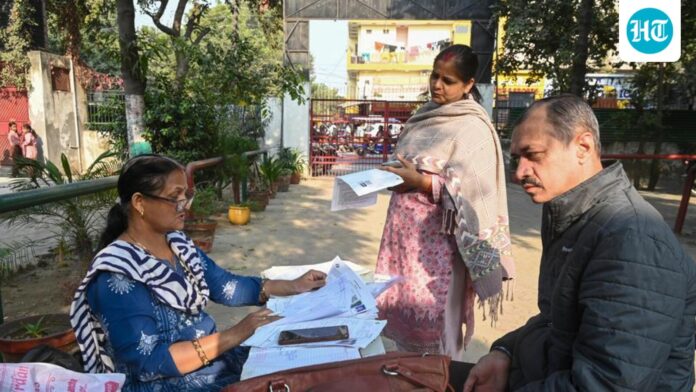

GREATER NOIDA: Gautam Budh Nagar district administration has launched one of its widest-ever Special Intensive Revision (SIR) drives, extending voter enrolment camps from industrial belts and labour clusters to universities, high-rise societies, hospitals, corporate parks and Noida’s Film City. On Monday, the district rolled out over 500 special camps between 12 pm and 2 pm, with an equal number scheduled again on Tuesday to maximise voter turnout during lunch hours.

These include 50 camps in labour-dense zones, 50 camps in major industrial units, 35 camps in universities and medical institutions, camps at 1,868 booths across Noida and Greater Noida, dedicated camps at 16 media houses across Noida Film City and adjoining office clusters.
Officials said all camps are accepting Form 6, Form 8 and other enumeration forms, with district officials clarifying that forms for any booth may be submitted at any camp. BLOs have been instructed to help shift voters transition seamlessly or file Form 8 on the spot.
With high population mobility in the corporate and media sectors, the district has prioritised on-site enrolment at workplaces.
Camps were operational at units such as Samsung, LG, Dixon, Vivo, Oppo, Kent, CNH, BPL, Motherson, Uflex, Sheela Foam, Haldiram, Surya Foods, Denso, Minda, PPAP Automotive, and Yamaha’s Surajpur facility.
In Noida’s Film City, voter services were brought directly to newsrooms including Hindustan, Aaj Tak, News 24, Times Now, Dainik Jagran, Amar Ujala, Indian Express, India TV, Network 18, Zee Media, NDTV, ABP News, Bharat 24,and others.
“This wide coverage – from factories to studios – ensures that people who cannot step out during working hours still receive full voter services,” said district magistrate and district election officer Medha Roopam.
Officials said the aim is to ensure no eligible voter is left out ahead of the 2026 electoral roll publication.
Roopam said the administration is running the campaign with “maximum transparency, simplified processes and wide public access”, with cooperation from RWAs, Apartment Owners’ Associations, industry bodies, labour unions and media organisations driving the effort.
“We have already digitised 65.7% of the forms that have come back, and verification has confirmed that about 7.2% of entries relate to voters who have shifted or are no longer alive. Our BLOs are working with exceptional speed and accuracy – 35 of them have already completed 100% digitisation – and this momentum will continue,” the DM said.
Camps in Sharda University, Gautam Buddha University, Amity University, and multiple professional colleges saw active participation from students, many of whom are first-time voters.
The Election Commission of India on November 30 issued a revised schedule for the Special Intensive Revision, extending all major stages of the process by one week across 12 states and UTs.
Under the updated timeline, the enumeration period and rationalisation of polling stations will now continue until December 11, while the updation of the control table and preparation of the draft roll will take place from December 12 to 15.
The draft electoral roll will be published on December 16, followed by the claims and objections window from December 16 to January 15.
The notice phase – including issuance, hearings, verification, and disposal of claims and objections – will run concurrently from December 16 to February 7.
Districts will then undertake health parameter checks and seek the Commission’s approval for final publication by February 10, before releasing the final electoral roll on February 14, 2026.
Officials said the extension will allow more thorough verification of EF forms, especially in cases of address mismatch, shifted voters and corrections flagged during door-to-door surveys.
“The extended SIR timeline announced by the Election Commission will help us verify every remaining case, especially address mismatch entries and corrections flagged during field surveys. Our objective is not just enrolment but a clean, accurate and fully updated electoral roll,” she added.