


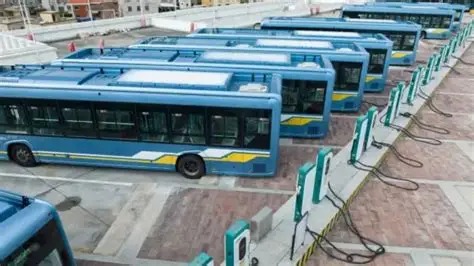
Greater Noida West : Greater Noida West residents have been waiting for a functional city bus service for nearly 15 years. Despite repeated announcements and route plans over the years, not a single regular city bus has operated consistently in the area. Now, the Greater Noida Authority has once again announced a plan to run 15 to 20 electric buses across four routes, keeping connectivity to the upcoming Noida International Airport in focus. But residents remain sceptical.
A 15-year-old pomise
City bus services were first announced in Greater Noida West around 15 years ago. Since then, multiple proposals have surfaced, yet none have translated into sustained ground-level implementation. Today, more than 5 lakh residents depend largely on private vehicles, autos and e-rickshaws for daily commuting. Public transport infrastructure remains underdeveloped in a region that has witnessed rapid vertical growth and dense residential expansion.
The new e-bus proposal: Four routes planned
According to Greater Noida Authority CEO NG Ravi Kumar, the proposal includes four routes connecting key residential and commercial hubs to the airport.
Proposed Route 1:
Char Murti Chowk – Authority Office – City Park – Alpha Commercial Belt – Pari Chowk – Airport
Proposed Route 2:
Gaur City and nearby societies – 60 Meter Road – Hanuman Mandir Chowk – Bisrakh – Surajpur Collectorate – LG Chowk – Jagat Farm – Yatharth Hospital – Apollo Hospital – Gautam Buddha University – Airport
Routes 3 and 4:
Chhapraula Flyover – Makoda Gol Chakkar – Beta 1 – Beta 2 – Jagat Farm – Sharda University – India Expo Mart – Noida Greater Noida Expressway – Airport
The authority is reportedly coordinating with UP Roadways for the first phase rollout.
The big question: Where is the infrastructure?
While route planning has been outlined, serious infrastructure gaps remain:
- No permanent city bus terminal
- No developed bus depots
- No charging stations for electric buses
- No designated parking or maintenance zones
Residents argue that announcing routes without creating physical infrastructure could lead to yet another stalled initiative.
Earlier, a much larger proposal of deploying 500 e-buses in Greater Noida West had been announced, but it never progressed beyond paperwork. Now the scale has reduced to 20 buses across four routes, raising questions about operational viability for a population exceeding five lakh.
Residents react
I am living in Greater Noida West since 2017 and has heard repeated promises of public transport development. However, no concrete system has been established so far.
Sumit Gupta, Elegant Ville
I welcome the idea in principle but what about the feasibility. Deploying only 20 buses for such a large population may not significantly ease commuting pressure. I am surprised that this move is an attempt to calm the ongoing demand for metro connectivity.
Dipankar Kumar, Panchsheel Greens 2
If the city bus service itself has not stabilized, discussions around metro expansion appear premature.
Sumil Jalota, La Residentia
Meanwhile, Abhishek Kumar, President of the Greater Noida West residents’ body NEFOWA, termed the decision a positive step but stressed that execution and accountability now lie with the authority.
A reminder from the past
Before the COVID-19 pandemic, four city buses were briefly introduced in Greater Noida West. However, due to low frequency and the pandemic disruption, services were discontinued and never revived.
Since then, not a single regular city bus has operated in the region.
Will this time be different?
The announcement of 20 electric buses may signal intent, especially with airport connectivity becoming a strategic priority. However, without:
- Dedicated depots
- Charging infrastructure
- Operational scheduling transparency
- Long-term financial planning
The plan risks becoming another headline without implementation.
For residents of Greater Noida West, the issue is no longer about announcements. It is about delivery.
Whether this promise finally translates into buses on the road remains to be seen.